
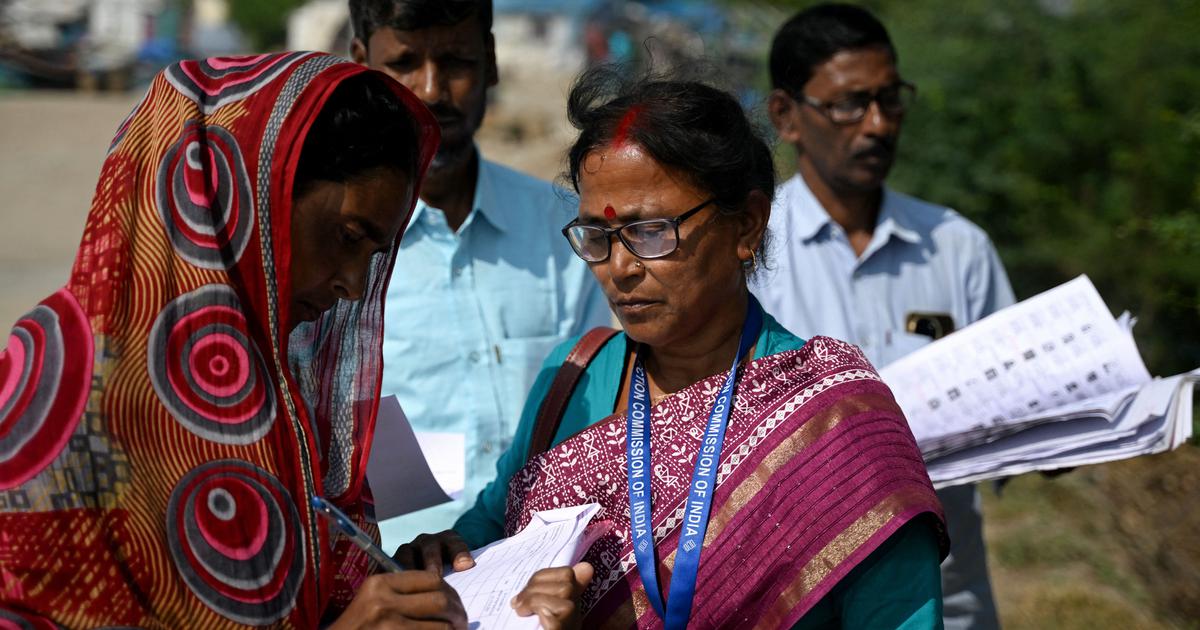
As the political war between the ruling Trinamool Congress (TMC) and the Bharatiya Janata Party (BJP) personified in the high-octane barns between the West Bengal Chief Minister Mamata Banerjee and the Union Home Minister, Amit Shah rages to a crescendo, rumours of a February 2026 election notification are doing the rounds in the capital. Even as hearings for those excluded from the controversial SIR stand delayed/postponed, multiple reports of serious anomalies in the ongoing Special Intensive Revision (SIR) process being unilaterally conducted by the Election Commission of India (ECI) in West Bengal have come to light; exclusion of Matuas, immigrants from erstwhile east Bengal, is only one of them
Today, New Year’s Eve, December 31, a delegation of Parliamentarians belonging to the TMC met with Gyanesh Kumar (Chief Election Commissioner-CEC) and submitted a detailed memorandum.
— All India Trinamool Congress (@AITCofficial) December 31, 2025
Yesterday, December 30, 5-member delegation of state political representatives and MLAs met the State Election Commission demanding “immediate release of the “Logical Discrepancy” list, an extension of doorstep hearing timelines for senior citizens, and the inclusion of BLA-2 representatives in SIR hearings, and submitted a memorandum. The memorandum states that “these demands are vital to ensure transparency in voter lists. Ending needless harassment and protecting senior citizens’ rights will strengthen the very foundation of democracy”
Calling for the immediate release of the “Logical Discrepancy” list, an extension of doorstep hearing timelines for senior citizens, and the inclusion of BLA-2 representatives in SIR hearings, a five-member delegation of the All India Trinamool Congress submitted a memorandum to… pic.twitter.com/0FnaEN5BA8
— All India Trinamool Congress (@AITCofficial) December 30, 2025
Controversy was first generated with the December 27 announcement by the ECI that it was “halting” the previously announced and notified Bengal hearings over 2002 electoral roll glitch! Rediff.com reported that the EC has issued instructions afresh to district election officials in West Bengal, directing that voters marked as “unmapped” in the BLO app due to technical issues linked to the digitisation of the 2002 electoral rolls during the ongoing SIR exercise should not be called for hearings, even if such notices have been auto-generated by the system. This promises to create hardship and confusion on the ground especially to the elderly and differently abled leading to sharp criticisms from the state government and ruling party.
The directive published on the portal and issued by the office of the Chief Electoral Officer (CEO), West Bengal, on Saturday, December 27, stated that the issue has arisen due to incomplete conversion of the PDF version of the 2002 electoral rolls, the last Special Intensive Revision (SIR) conducted in the state, into CSV format, leading to linkage failures in the booth-level officer (BLO) app for a number of electors. The announcement stated that despite being marked as “unmapped” in the system, many such electors have valid self or progeny linkage with the hard copy of the 2002 electoral rolls, duly authenticated by district election officers (DEOs) and published on the CEO’s website. Going further, the CEO’s office said that hearing notices generated automatically in such cases need not be served and should be retained at the level of the electoral registration officer (ERO) or assistant electoral registration officer (AERO).
Sabar Institute: Analysis shows many permanently shifted, untraceable voters in Matua-dominated seats
The refugee (immigrant) community of Hindu refugees largely residing in North 24 Parganas and Nadia district have been apprehensive of exclusion in the SIR since they lack the appropriate “legacy data”. The analysis was conducted in about 15 Matua-dominated Assembly constituencies by the Kolkata-based Sabar Institute. It revealed from analysis that, an average 33.95% deleted voters have been described as permanently shifted. The average number of untraceable/ absent voters across these 15 constituencies stands at 21.56%. These 15 constituencies are located in North 24 Parganas and Nadia districts. The highest per cent of deletions on account of untraceable/absent voters is from the Krishnaganj Assembly seat in Nadia with 42.11% deletions. This was followed by Ranaghat Uttar Purba with 34.56% deletions on account of untraceable/ absent voters in the same district. This study has been reported in detail in The Hindu on December 29.
The highest per cent of deletions on account of permanently shifted voters was recorded in Bangaon Dakshin constituency with 41.76% deletions. This was followed by 38.46% deletions in Swarupnagar on account of permanently shifted voters. Both these constituencies are located in North 24 Parganas. ((Providing details to local and national media, institute stated that the collaborative evidence-based analysis of the SIR exercise in West Bengal was done by Ashin Chakraborty and Souptik Halder. “In constituencies such as Krishnaganj, ‘untraceable/absent’ has become the main reason for voter deletion, which is uncommon in most parts of the State. This is a serious issue and needs urgent attention, especially because the Matua community is already socially and economically marginalised,” Mr. Chakraborty said.
The researchers have also held a surname analysis in the Matua belt across these 15 constituencies which point out that people with the surname “Biswas “have accounted for the highest 20.79% deletions. This is followed by persons with Mondal surname with 17.83% deletions and Das surname with 10.78% deletions. All the three surnames are generally used by the Matua population.
Matuas are a social group largely comprising Namashudras who have migrated from Bangladesh over the past several decades. The community of Hindu refugees largely residing in North 24 Parganas and Nadia district have been apprehensive of the SIR since they lack legacy data. The SIR fears have over the past few weeks have prompted the Matuas to apply for citizenship under the Citizenship (Amendment) Act 2019.
Local Officials flag systemic errors and consequent large-scale voter deletions
Meanwhile, a West Bengal based Officers association, reported the Hindu, has expressed concern that names may be deleted from voters’ list without the knowledge of the Electoral Registration Officer. In a letter to West Bengal Chief Electoral Officer Manoj Agarwal, with a copy to Chief Election Commissioner Gyanesh Kumar’s office, the West Bengal Civil Service (Executive) Officers’ Association on Wednesday flagged the “suo moto system-driven deletion of electors from the draft electoral rolls in West Bengal in the ongoing SIR process bypassing the statutory role of EROs”. This anomaly could put the EROs (Electoral Registration Officers) in West Bengal in a piquant situation– an association of state service officers has flagged a serious concern over the potential of widespread, system-driven exclusions/deletions of voters that they (EROs) would be blamed for though they had no part in the generating of notices.
West Bengal based Booth Level Officers have also protested outside the state office of the Election Commission (December 1).
#WATCH | Kolkata, West Bengal: Booth Level Officers (BLOs) engaged in SIR exercise hold a protest outside the office of the Election Commission. pic.twitter.com/47xOqI35FU
— ANI (@ANI) December 1, 2025
Under the law and existing rules, the EROs are the sole and competent authority to issue notices if they have any doubts on a voter’s eligibility, be it citizenship or anything else, under the Representation of People Act, 1950. However, in the ongoing Special Intensive Revision (SIR) of electoral rolls, the ECI’s centralised portal has been used to generate notices. Meanwhile The Indian Express had also reported on December 16 that EROs across Bihar had found “pre-filled notices” appearing on their individual log-ins on the ECI’s centralised portal. Significantly, while the notices bore the names of the EROs, they had not been generated by them.
An Electoral Registration Officer (ERO) in West Bengal, who did not wish to be named, said notices are generated by the ECI software, and not by the officer concerned. “We have an option/button for notice generation. When we use it, notice is automatically generated. At present, the software generates notices for voters who are not mapped with the 2002 SIR data. Thereafter notices to these voters are sent. However, in the case of voters with ‘logical discrepancies’ in data, we have no power to decide which elector will be called for a hearing. That will be decided only by the ECI,” the ERO in Nadia district said.
In this letter to the CEC, Saikat Asraf Ali, General Secretary of the state civil service officers association said, “It is observed that names of electors might be deleted from the electoral roll without the knowledge of the ERO who is the competent authority as per the statute. The common people who will be affected by such action will only blame the ERO without knowing that the ERO has been kept out of the entire deletion process by the Commission.”
When contacted, Ali told this newspaper that the association wants ECI to follow the law and be transparent. “If they make deletions, and what they have done so far, they should clarify to people that the ERO is not responsible for the deletions. Otherwise, people will blame us. We also don’t want any genuine elector’s name to be deleted,” he said.
An official in the West Bengal CEO office, however, said detailed instructions were given to all DEOs (District Election Officers), EROs and AEROs in October itself before SIR work commenced in West Bengal. “Why are the officers raising such questions now? Only those electors who have no mapping with 2002 SIR are being served notices to come for hearing. That number is around 31 lakhs in West Bengal. After this, ECI will start scrutinising the voters with ‘logical discrepancies.’ Then it will be decided by the ECI how those notices will be generated,” the official told The Indian Express.
“It has been found on the date of the draft publication that a considerable number of electors, whose Enumeration Forms have not been returned on alleged grounds such as death, migration, absence, or duplication, have been deleted from the draft electoral rolls,” the association had said in its communication. “Seen against the existing legal provisions as enumerated in the Representation of the People Act, 1950 read with the Electoral Registration of Electors Rules, 1960, it is observed that the law clearly mandates that an elector’s name can be deleted with care on special grounds such as, when ‘the person concerned has ceased to be ordinarily resident in the constituency or that he is otherwise not entitled to be registered in the electoral roll of that constituency’ and also, in all such cases, ‘the electoral registration officer shall give the person concerned a reasonable opportunity of being heard in respect of the action proposed to be taken in relation to him’ (Section 22 of the Representation of the People Act, 1950). EROs have been assigned an integral role in the entire registration process in this regard,” it said.
ERO: Sole authority for voter deletion
AT the heart of the issues raised by the West Bengal officers’ association is the claim that names of persons may be deleted from voters’ list without the knowledge of the Electoral Registration Officer, who is the competent authority as per law to send notices and decide if a person is a legitimate voter.
West Bengal CEO Agarwal had earlier said in a press conference that the hearings for those who could not be mapped with the electoral roll of the last intensive revision in 2002 would begin first and those with “logical discrepancies” would be studied.
“Some electors fall in multiple categories of discrepancies. So, the unique number of logical discrepancies is 1.36 crore and no mapping numbers stand at 31 lakhs, totalling at 1.67 crore. But after analysis, the numbers could change,” he had said.
The WBCS officer’s letter came on the same day that the Election Commission wrote to the CEOs of the 12 states and UTs where the SIR is ongoing, giving fresh instructions to verify all documents submitted by electors with the respective District Election Officers to establish their eligibility within five days – something which was not done in the SIR in Bihar. The Indian Express sent a detailed query to the ECI, which did not respond till the time of writing.
The WBCS officers’ letter concluded, “In view of the above, we request your good office to issue necessary instructions so that the EROs may function with greater clarity in their works and authority commensurate with their statutory responsibilities, considering the fact that the final electoral rolls will be published under his signature and seal alone and under the aegis of Election Commission of India.”
(Report based on inputs from The Hindu, The Indian Express and Rediff.com)
Related:
SIR 2025 in Bengal: 5 Key Takeaways That Strike at BJP’s ‘Infiltration’ Bogey