
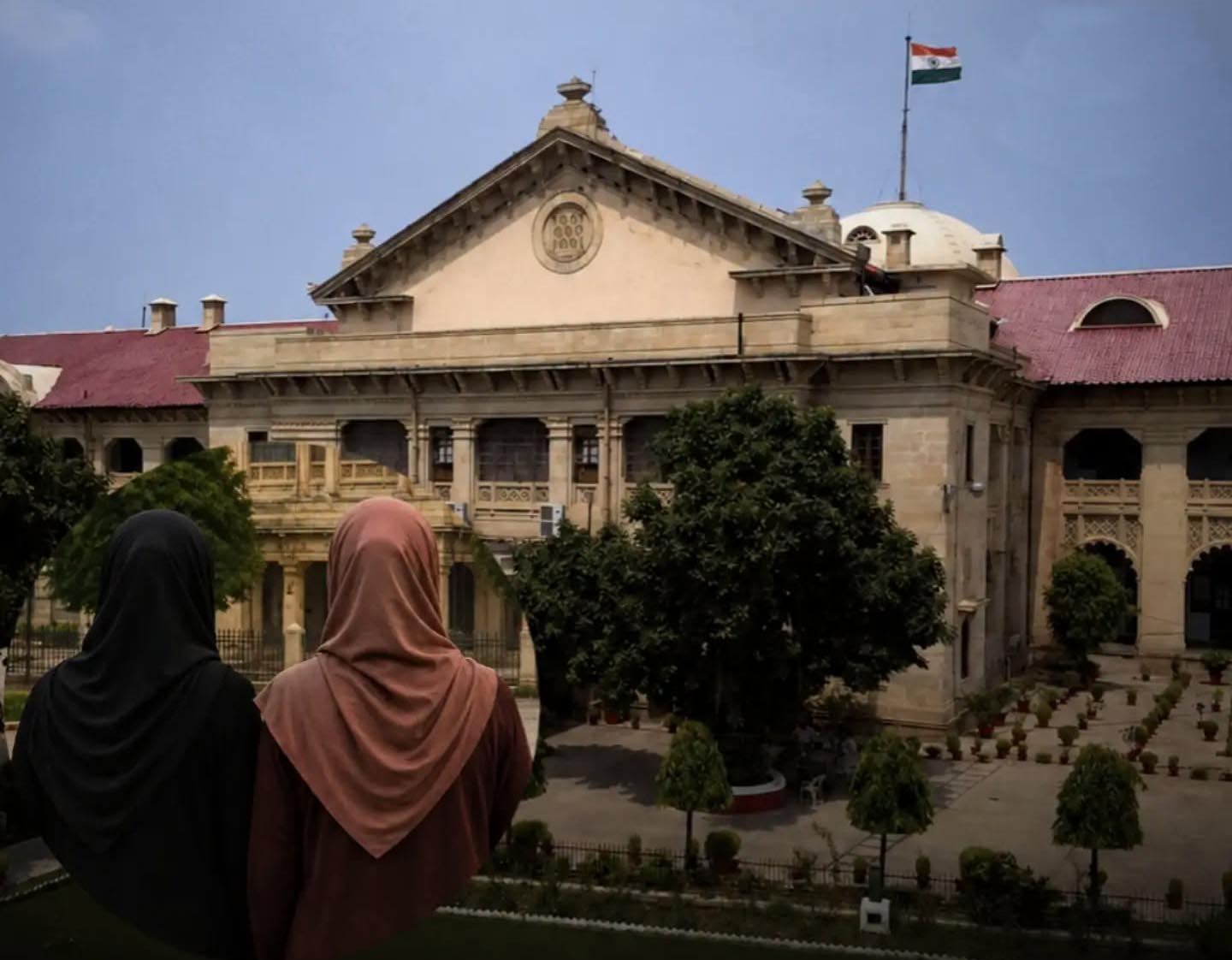
In a significant habeas corpus judgment, the Allahabad High Court has drawn a constitutional boundary between the State’s power to investigate an alleged unlawful religious conversion and the individual’s right to personal liberty. Justice Sandeep Jain held that two adult women could not be confined by their father merely because they had chosen to embrace a faith different from that of their family, even while an investigation into the alleged conversion remained pending. The Court held the detention wholly illegal, found the State machinery responsible for allowing the confinement to continue, and awarded ₹25 lakh in constitutional compensation.
At one level, the case concerned two women who said that they had voluntarily embraced Islam and were subsequently confined by their father. But the legal question before the Court was considerably broader: can the alleged illegality of a person’s religious conversion justify the continued physical confinement of that person when she is an adult, competent, and unequivocally asserts that the choice was voluntary?
The Court answered in the negative. More importantly, it refused to allow the criminal investigation into the alleged conversion to collapse the distinction between two separate questions: whether the conversion was lawful, and whether the women could lawfully be detained.
“The present case discloses an exceptionally grave and egregious violation of constitutional rights. The corpus, despite being major, educated and legally competent women, were deprived of their liberty for a prolonged period commencing from the year 2021, solely because they exercised their constitutionally protected freedom of conscience and chose to profess a religion different from that professed by their family. Such prolonged and coercive confinement strikes at the very foundation of constitutional democracy, which recognises the autonomy of every adult individual as sacrosanct and beyond the reach of parental or societal control. The constitutional guarantee of personal liberty cannot be permitted to yield to familial disapproval, social orthodoxy or executive apathy.” (Para 65)
“Before parting, this Court deems it necessary to reiterate that the Constitution does not confer upon parents a licence to incarcerate their major children merely because they disapprove of their faith, beliefs or personal choices. Constitutional rights cannot be eclipsed by parental authority, social morality or majoritarian sentiment. The liberty of an adult individual is inviolable, and any attempt to suppress that liberty by force or coercion invites the constitutional scrutiny of this Court and attracts appropriate public law consequences, including the award of monetary compensation for the infringement of fundamental rights.” (Para 66)
The former, the Court held, could be examined by the competent authority or court. The latter was squarely before the High Court in habeas corpus jurisdiction. The judgment consequently becomes a strong reaffirmation of decisional autonomy, freedom of conscience, the limits of parental authority, the scope of habeas corpus against private detention, and the State’s public-law liability when its machinery permits an unconstitutional deprivation of liberty to continue.
Two adult women before the constitutional court
The petition concerned Anshu Bhatia @ Amina Anshu Bhatia, aged about 35 years, and Diya Bhatia @ Zoya Diya Bhatia, aged about 20 years. By an order dated July 30, 2026, the State was directed to produce both women before the High Court. They were subsequently produced before Justice Sandeep Jain by police officials from the Cyber Crime Police Station, Agra.
The Court then did something crucial for a habeas corpus proceeding involving allegations of coercion: it interacted with the women directly. Anshu told the Court that she had voluntarily embraced Islam in 2020, describing the decision as a conscious and independent choice motivated by mental peace, spiritual fulfilment and inner solace. She stated that the decision was not the result of inducement, influence, coercion, undue persuasion or any extraneous consideration. She further stated that her father strongly opposed the decision and subsequently confined her within the parental home. According to her, physical restraint, intimidation and sustained mental harassment were used to compel her to renounce the faith she had chosen and return to Hinduism.
Diya, who had completed her education up to the Intermediate level, similarly told the Court that she had voluntarily embraced Islam in 2021, motivated by personal faith, conscience, mental peace and spiritual solace. She too denied force, fraud, coercion, undue influence or allurement.
Both women consistently maintained before the Court that their decisions were voluntary and conscious and arose from their own individual faith and freedom of conscience. They also denied that their conversion was motivated by an extraneous, unlawful or pecuniary consideration or intended to advance the interests of any individual or organisation. The dispute therefore came before the High Court in a very specific constitutional form: Were these adult women unlawfully confined by their father against their own wishes?
The State’s case: This was not merely a family dispute
The State strongly opposed the habeas corpus petition. The father had lodged Case Crime No. 228 of 2025 at Police Station Sadar Bazar, District Agra, alleging that the women had been subjected to forcible and deceitful conversion from Hinduism to Islam. The FIR was initially registered under Section 87 of the Bharatiya Nyaya Sanhita, 2023.
During investigation, the investigating agency subsequently added:
- Sections 61(2), 111(3), 111(4) and 152 of the Bharatiya Nyaya Sanhita, 2023; and
- Sections 3/5(1) and 5(2) of the Uttar Pradesh Prohibition of Unlawful Conversion of Religion Act, 2021.
The State argued that the addition of these provisions demonstrated that the allegations of voluntary conversion could not simply be accepted at face value. But the State went considerably further. Its case was that the alleged conversion was part of a larger and organised conspiracy with ramifications for the sovereignty, integrity and unity of the nation.
It claimed that the investigation had uncovered material indicating the involvement of organised persons pursuing a coordinated design to disturb the social fabric through unlawful religious conversions.
The State also referred to alleged involvement of foreign entities and external influences, arguing that the investigation was continuing and that releasing the women could prejudice the proceedings. It further contended that the women had been projected as victims in the criminal case and that allowing them to reside with persons allegedly connected to the investigation could influence witnesses, prejudice the prosecution and frustrate the administration of criminal justice. The State therefore attempted to place the case within a much larger framework of public order, national interest and security.
The High Court was not persuaded.
Findings of the Court
- What is the scope of habeas corpus?
Before determining whether the detention was illegal, Justice Sandeep Jain examined the nature of the writ itself. The Court relied upon the Supreme Court’s judgment in Home Secretary (Prison) v. H. Nilofer Nisha, where the Supreme Court explained that habeas corpus is available wherever a person is deprived of personal liberty unlawfully or without justification.
Importantly, the Supreme Court authority recognises that habeas corpus is not confined to State detention. It can also be invoked against private detention. The Allahabad High Court quoted the principle that the writ is available for release from detention not only by the State but also from private detention. This becomes central to the case as the father was not a State official exercising a statutory power of detention. The alleged confinement was taking place inside the parental home. But that did not take the matter outside Article 226. The constitutional inquiry was simple: Was there lawful authority for the restraint?
- A parental home is not a legal prison—but it cannot become one
The judgment’s treatment of private detention is especially significant. The women were allegedly confined in their parental home. That fact could easily have been used to characterise the dispute as a family matter. Thankfully, the Court refused to do so. Habeas corpus exists precisely because the law is concerned with the fact of unlawful restraint, not merely the formal label attached to the person exercising it. The relevant question was not whether the father believed he was acting in the interests of his daughters. The question was whether he had legal authority to restrain two adult women. The Court ultimately found that he did not.
- Majority marks the constitutional end of parental custody
The Court relied on a line of constitutional jurisprudence concerning the autonomy of adult women. One of the authorities discussed was the Supreme Court’s decision in Soni Gerry v. Gerry Douglas. There, the Supreme Court held that once an individual attains majority, she is entitled to make her own choices and that courts should not assume the role of a super-guardian merely because a parent disapproves of that choice.
The Allahabad High Court also considered the Kerala High Court’s decision in Rajamohan MS v. State of Kerala, which dealt specifically with parental attempts to restrain an adult woman. That decision recognised that parental authority may extend to advice, counselling and guidance, but not to confinement or detention against the wishes of an adult daughter.
The Allahabad High Court reproduced the proposition that an adult major woman cannot be treated as a “chattel” and that parental authority does not give a parent the right to keep her under restraint against her will. This jurisprudence supplies the conceptual foundation for the present ruling. Once adulthood is attained, the parent-child relationship does not disappear. But its legal character changes.
- The Court rejects the idea that parents know what is “best” for adult women
The reliance on Rajamohan MS case is particularly important because it confronts a deeply embedded paternalistic assumption: that parents should be permitted to control adult women’s decisions because they believe those decisions are wrong, imprudent or harmful. The jurisprudence cited by the High Court rejects that logic.
An adult’s decision does not lose constitutional protection simply because the decision might later prove to be unwise. The Kerala High Court authority, quoted in the judgment, makes the point that courts cannot permit the concepts of parents about what is “right and good” for their adult daughters to override the daughters’ own assessment of what is right for them. This principle is particularly relevant in the present case.
The women’s choice concerned religion—a matter inherently connected to conscience and identity. The Constitution cannot recognise individual autonomy while simultaneously allowing family members to exercise a veto over the individual’s conscience.
- Reliance on Shafin Jahan to hold that constitutional courts are not super-guardians
The judgment also invokes Shafin Jahan v. Asokan K.M., one of the Supreme Court’s most crucial decisions on individual autonomy. The High Court notes the Supreme Court’s recognition that constitutional courts may exercise parens patriae jurisdiction for persons who are incapable of exercising free will, such as minors or persons of unsound mind. But that principle cannot be extended to competent adults simply because their choices are controversial or disapproved of by others.
The Supreme Court in Shafin Jahan emphasised that decisions concerning intimate and personal matters belong to the individuals concerned and that neither State nor society can intrude into that domain merely because they disapprove of the choice. The Allahabad High Court uses that jurisprudence to reinforce a fundamental distinction: A constitutional court protects an adult’s autonomy; it does not replace it.
The Court therefore did not ask whether it believed the women’s religious choice was sensible. It asked whether the women themselves had made the choice freely. Once the answer was yes, the constitutional duty was to protect that choice from unlawful restraint.
- The Court personally tests voluntariness
This is where the Court’s interaction with the women becomes legally decisive. Justice Sandeep Jain recorded that the responses of both women were: “spontaneous, coherent and unequivocal.”
Nothing emerged during the interaction to suggest that they were acting under coercion, fear, inducement or undue influence. On the contrary, both consistently asserted that they had voluntarily embraced Islam as a matter of personal faith and conscience. The Court therefore did not simply accept the women’s claims because they were petitioners. It independently interacted with them. This matters because the State’s central argument was that their assertion of voluntariness was false and that they had been made instruments of an organised conversion network. The Court found no material before it sufficient to draw that inference.
- Article 25: “Freedom of conscience” includes the freedom to change faith
The Court then turned to Article 25. It held that the constitutional guarantee of freedom of conscience necessarily encompasses the right of a competent adult to adopt a faith, renounce a faith, or change her faith according to her own free will, belief and conviction. The Court did not conceptualise Article 25 merely as protecting the practice of an inherited religion. It recognised conscience as a matter of individual choice.
The Court held that such a decision is an essential facet of: individual autonomy, dignity and personal liberty. It is therefore protected not only under Article 25, but also under Article 21. If freedom of conscience means anything constitutionally, it cannot mean merely the freedom to remain within the religious identity assigned by one’s family. It must include the freedom to arrive at one’s own conviction. And where an adult voluntarily changes her faith, that choice cannot ordinarily be dictated by either the family or the State except within constitutionally permissible restrictions and the authority of law.
- The Uttar Pradesh Conversion Act does not answer the detention question
The State relied heavily on the Uttar Pradesh Prohibition of Unlawful Conversion of Religion Act, 2021. The Court acknowledged that the Act provides the statutory framework governing unlawful religious conversions and prescribes procedures concerning conversions. But the Court made an important jurisdictional observation: The vires of the 2021 Act had not been challenged before it. Nor was the legality or validity of the alleged conversion itself the subject matter of the habeas corpus proceedings. Any question concerning compliance or non-compliance with the Act was therefore left to the competent authority or court. The Court then reached the central distinction: “The legality of the conversion and the legality of their detention constitute two distinct and independent issues.” This distinction is the backbone of the judgment.
The Court went further. It said that even assuming, for the sake of argument, that the conversion had not been carried out strictly according to the procedure prescribed under the 2021 Act, that assumption would not itself authorise the father to continue confining the women. This is a crucial rule-of-law proposition. An alleged violation of one law does not automatically create a power under another law to deprive a person of liberty. If the conversion was unlawful, the State could investigate it. If an offence was established, the criminal law could operate.
But the father could not become the custodian of the women merely because he believed their religious conversion was illegal. The State could not use the pendency of that investigation to permit the confinement to continue. Thus, the Court separates regulation from detention. The State may regulate conduct through law; however, it cannot manufacture a detention power that the law does not confer.
- National security cannot rest on assertion alone
The State’s invocation of sovereignty, integrity and national security was also examined closely. The Court found that, apart from broad assertions based on the FIR and the pendency of investigation, no material had been placed before it demonstrating that the voluntary exercise of religious choice by these women, by itself, constituted a threat to the sovereignty, integrity or security of the country. The Court therefore refused to accept the argument.
The court held that mere apprehensions, however serious they may appear, cannot substitute legally admissible material while adjudicating upon the fundamental rights of citizens. This is not a finding that national-security considerations can never justify restrictions on liberty. Rather, it is a rejection of conjecture as constitutional evidence. The seriousness of the allegation does not eliminate the need for material. A court deciding whether a fundamental right has been infringed cannot treat the language of “national security” as a substitute for proof.
- The Court refuses to infer an “oblique motive”
The Court also rejected the suggestion that the women were merely instruments in a larger unlawful design. After interacting with them, the Court said it could not discern material warranting an inference that they had acted with an oblique motive or had been reduced to instruments in the hands of an individual or organisation pursuing an unlawful agenda.
Such an inference, the Court held, could not legitimately be drawn from conjectures, surmises or allegations that remained to be tested before the competent criminal court. This distinction is significant as the Court did not adjudicate the criminal allegations, rather it simply refused to allow untested allegations to determine the constitutional status of the women before it. The criminal investigation was therefore left intact. But it was not allowed to become a basis for continuing their detention.
The investigation arising from Case Crime No. 228 of 2025 would continue strictly in accordance with law. But, the court held that mere pendency of a criminal investigation cannot, by itself, furnish a lawful justification for curtailing the liberty of adult citizens, particularly where they are not subject to any judicial or other lawful order of detention.
This is one of the judgment’s most important safeguards. A criminal investigation is a process for determining whether an offence has been committed. It is not, by itself, a source of custody. The existence of an FIR cannot turn a private residence into a lawful detention centre. Nor can the seriousness of the allegations eliminate the requirement that any deprivation of liberty have legal authority.
Parental authority yields to constitutional liberty: Compensation and directions
Having found the detention to be wholly illegal, the Court did not confine the remedy to a declaration that the women were free. It recognised that where a serious and prolonged violation of fundamental rights has already occurred, an order of release alone may not provide an adequate constitutional remedy. The Court therefore invoked the established jurisprudence on constitutional compensation, particularly Rudul Sah v. State of Bihar and Nilabati Behera v. State of Orissa. These decisions establish that constitutional courts exercising jurisdiction under Articles 32 and 226 can award monetary compensation for egregious violations of fundamental rights as a public-law remedy. Such compensation is distinct from ordinary private-law damages and is intended to provide meaningful redress for the breach of a public duty to protect fundamental rights.
Applying this principle, the Court found the present case to involve an “exceptionally grave and egregious violation of constitutional rights.” It took into account the fact that the women were adults and legally competent, the prolonged nature of their deprivation of liberty, the circumstances in which the confinement allegedly followed their exercise of freedom of conscience, and the mental and psychological consequences of the restraint. The Court also considered the failure of the State machinery to discharge its constitutional obligation to protect their liberty. It described the conduct as a “flagrant affront to the Rule of Law” and found that the State, rather than securing their release, had allowed the detention to continue under the ostensible cover of criminal proceedings. The award of compensation was therefore not presented as punitive damages or an ex gratia payment, but as a constitutional remedy flowing from the gravity of the fundamental-rights violation.
The Court consequently held the father and the State of Uttar Pradesh jointly and severally liable to pay ₹25 lakh, with the amount to be equally divided between the two women. The judgment also incorporated an important mechanism for individual accountability within the State machinery. After satisfying the compensation award, the State was permitted, subject to due process and an opportunity of hearing, to recover the stipulated share from the father and from any delinquent public servant whose acts or omissions contributed to the unconstitutional deprivation of liberty. This aspect of the order is significant because it moves beyond merely compensating the victims and raises the question of institutional responsibility for allowing an unlawful deprivation of liberty to persist.
The Court’s directions were also designed to restore the women’s practical autonomy, rather than merely declare their freedom in abstract terms. It directed that they were free to reside at any place and with any person of their choice and restrained the father from interfering with their personal liberty, movement, residence, profession or religious choices. The State authorities were directed to ensure that no interference was caused to their peaceful life and liberty and to provide protection if required. These directions recognise that liberty can be undermined even without formal physical detention. If a person is denied access to her documents, finances, educational records or other personal belongings, her ability to independently exercise her constitutional choices may remain substantially constrained.
Accordingly, the Court directed the father to hand over the women’s passports, educational certificates, identity documents, bank passbooks, cheque books, conversion-related documents and other personal belongings within seven days, with the State authorities directed to ensure compliance where necessary. At the same time, the Court carefully limited the scope of its intervention: it did not determine whether the alleged conversion was legally valid, whether the criminal allegations would ultimately be established, or whether any offence had been committed. The investigation was permitted to continue strictly in accordance with law. The significance of the judgment therefore lies in the balance it draws between investigative power and individual liberty: the State remains free to investigate an alleged offence, but neither an investigation nor parental disapproval can become a substitute for lawful authority to deprive an adult of her liberty.
The complete judgment may be read here.
Related:
Two FIRs, Four Days In: Pune sees first use of Maharashtra’s controversial anti-conversion law
One Death Every Few Days, Zero Accountability: Sanitation workers protest at Jantar Mantar