
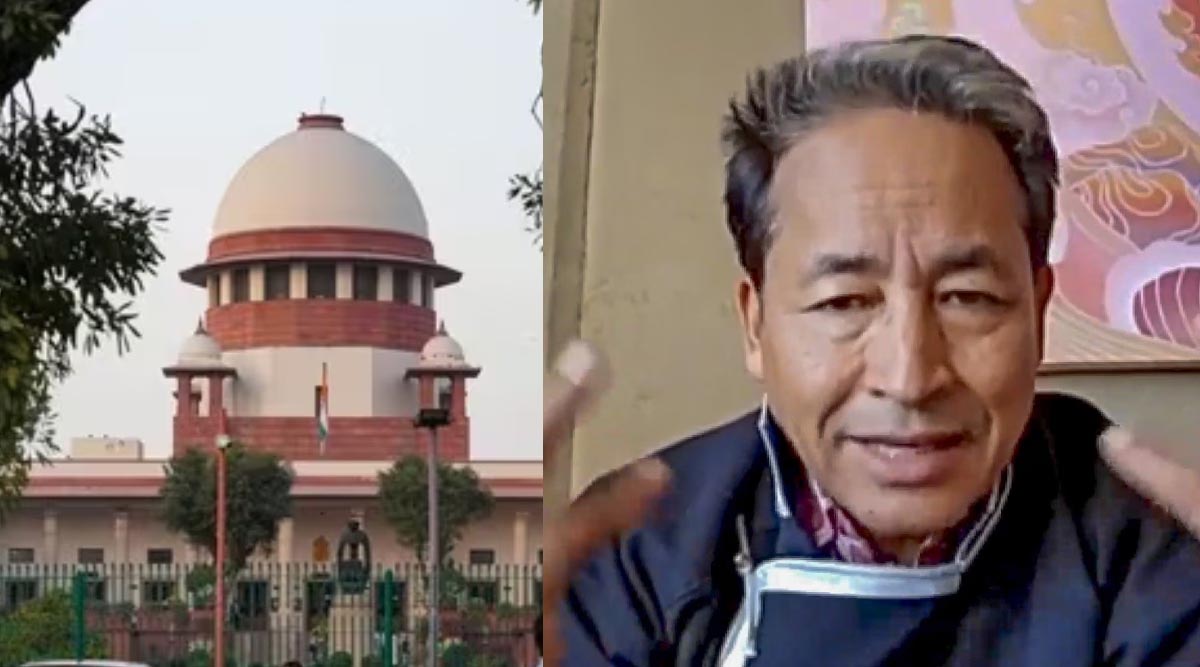
As the Supreme Court continues to hear the habeas corpus challenge to the preventive detention of Ladakh-based social activist, educationist, and climate campaigner Sonam Wangchuk, the Union Government has advanced an extraordinary case: that Wangchuk’s speeches sought to inspire Ladakhi youth by invoking protest movements in Nepal, Bangladesh, Sri Lanka, and the Arab Spring, thereby posing a grave threat to public order and national security in a sensitive border region.
Wangchuk was detained on September 26, 2025, under the National Security Act, 1980 (NSA), following weeks of protests in Ladakh demanding statehood and Sixth Schedule protection—a movement that later spiralled into violence, leading to the deaths of four civilians.
A Bench of Justice Aravind Kumar and Justice P. B. Varale is hearing the Article 32 habeas corpus petition filed by Wangchuk’s wife, Dr Gitanjali Angmo, which challenges the legality of his continued detention. Proceedings have been closely tracked by LiveLaw and other media.
Union’s core defence
- Court’s review is procedural, not substantive
Opening arguments for the Union, Solicitor General Tushar Mehta emphasised that judicial scrutiny in preventive detention matters is narrowly circumscribed. The Court, he argued, is not entitled to examine whether the detention was “justified”, but only whether statutory and constitutional procedures were followed so as to ensure fairness to the detenue.
Mehta relied on established precedent to submit that once the detaining authority records subjective satisfaction, courts must exercise restraint.
He further underscored the “inbuilt safeguards” within the NSA:
- The District Magistrate’s detention order must be confirmed by the State Government; and
- The detenue has a right to make a representation before an Advisory Board headed by a former High Court judge.
Crucially, Mehta pointed out that Wangchuk has not independently challenged either the confirmation order or the Advisory Board’s opinion, a submission clearly aimed at narrowing the scope of judicial interference.
- Dispute Over Supply of Materials: Union calls allegations an “afterthought”
Responding to the petitioner’s contention that four video clips relied upon in the detention order were not supplied to Wangchuk, Mehta rejected the claim as factually incorrect and a belated fabrication.
According to the Union, the service of the detention order itself took nearly four hours, during which a senior police officer personally went through each page of the grounds and the video material, a process that was videographed.
“The DIG Ladakh sits with him, shows him every page, every clip, and asks if he is satisfied. He answers in the affirmative,” Mehta told the Court, offering to place the recording on record if required.
- “Borrowed satisfaction” argument rejected
When the Bench raised the argument that the detention order was based on borrowed or mechanically reproduced material, Mehta countered that this misunderstands the nature of preventive detention.
He argued that a District Magistrate is not expected to personally witness each incident but is entitled—indeed required—to rely on inputs placed before him by law enforcement agencies to arrive at subjective satisfaction.
“What the authority must assess is the speech as a whole,” Mehta said, warning against isolating references to non-violence or Gandhian philosophy while ignoring the allegedly inflammatory core.
- Union alleges “hope for riot-like situation” in Ladakh
The centrepiece of the Union’s case lies in its reading of Wangchuk’s speeches. According to Mehta, Wangchuk deliberately invoked foreign protest movements to emotionally mobilise young people in Ladakh—a region that shares borders with volatile and geopolitically sensitive areas.
He referred to Wangchuk’s alleged references to:
- Nepal’s youth-led protests,
- Political upheavals in Bangladesh and Sri Lanka, and
- The Arab Spring, where multiple governments were overthrown following mass unrest.
“What is the relevance of Nepal and Ladakh?” Mehta asked. “You are not addressing Gen-Z in isolation—you are hoping for a Nepal-like situation.”
The Solicitor General dismissed Wangchuk’s invocation of Mahatma Gandhi as a rhetorical façade. “Gandhi was resisting an imperial power. He was not instigating violence against his own democratic government,” Mehta argued.
- Alleged security concerns and references to self-immolation
The Union further alleged that Wangchuk attempted to create distance between civilians and Indian security forces by lamenting the deployment of armed personnel in Ladakh.
“Security forces become ‘they’, and the people become ‘we’—this is dangerous in a border region,” Mehta submitted.
The most serious allegation concerned Wangchuk’s references to self-immolation, drawn from the Arab Spring narrative.
“This is an invitation to bloodshed,” Mehta claimed, arguing that such examples could incite impressionable youth to extreme and irreversible acts.
Petitioner’s response
- Non-consideration of crucial exculpatory material
On behalf of the petitioner, Senior Advocate Kapil Sibal mounted a systematic dismantling of the detention order in earlier hearings.
Sibal argued that the September 24 speech, in which Wangchuk broke his hunger strike and publicly appealed for peace after violence erupted, was the most proximate and relevant material—yet was never placed before the detaining authority.
Its suppression, he argued, vitiates the very foundation of subjective satisfaction, particularly when the speech was publicly available and known to authorities.
- Failure to supply relied-upon materials violates Article 22(5)
Sibal further submitted that four key videos, explicitly relied upon in the detention order, were never supplied to Wangchuk along with the grounds of detention, in violation of Article 22(5) of the Constitution and Section 8 of the NSA.
Without access to the complete material, Wangchuk was denied the right to make an effective representation—not merely before the Advisory Board, but also before the government itself.
- Section 5A cannot rescue a composite detention order
Rejecting the Union’s reliance on Section 5A of the NSA, Sibal argued that the provision applies only where distinct and independent grounds of detention exist.
Here, he said, the detention rests on a single composite ground, stitched together through selective videos, stale FIRs, and allegedly distorted interpretations.
Relying on Attorney General of India v. Amratlal Prajivandas (1994), Sibal submitted that a chain of events cannot be artificially severed to salvage an otherwise unlawful detention.
- Stale FIRs, copy-paste orders, and non-application of mind
Sibal also pointed out that:
- Several FIRs relied upon date back to 2024,
- Many are against unknown persons, and
- Even the FIR registered after the Ladakh violence does not name Wangchuk.
He further demonstrated that the District Magistrate reproduced the Superintendent of Police’s recommendation verbatim, betraying a mechanical exercise of power rather than independent application of mind.
- Allegations of anti-army rhetoric and plebiscite “completely false”
Addressing allegations that Wangchuk discouraged civilians from assisting the Indian Army during wartime, Sibal said the claim was entirely false, arising from mistranslation or deliberate distortion.
He quoted Wangchuk as urging Ladakhis not to mix political grievances with national defence, and to stand by the country during any external conflict.
Similar distortions, Sibal argued, were made regarding:
- Alleged support for plebiscite, and
- Claims of disrespect toward a Hindu goddess—both of which he described as manufactured narratives, widely debunked by fact-checkers.
Health, custody, and court-ordered medical care
Amidst these proceedings, concerns over Wangchuk’s health have also engaged the Court’s attention.
On January 29, the Supreme Court directed that Wangchuk be examined by a specialist gastroenterologist at a government hospital, after he complained of persistent stomach pain during his detention.
He was subsequently taken to AIIMS Jodhpur on January 31, where he underwent medical tests. While jail authorities claimed he had been examined 21 times, the Court accepted that specialist care was warranted and sought a report by February 2.
Voices Outside Court: Gitanjali Angmo speaks
Speaking to The News Minute at the Mathrubhumi International Festival of Letters in Thiruvananthapuram, Dr Gitanjali Angmo framed her husband’s detention as an attempt to silence a sustained and principled critique of how Ladakh is being governed after the abrogation of Article 370. She suggested that Sonam Wangchuk’s insistence on environmental safeguards and public participation in decision-making had increasingly placed him at odds with a governance model driven by centralised authority rather than local consent.
Dr Angmo emphasised that Ladakh’s demands for statehood and Sixth Schedule protection were neither sudden nor radical, but rooted in the region’s fragile ecology, high-altitude geography, and distinct cultural identity. With temperatures plunging to sub-zero levels and ecosystems highly vulnerable to disruption, she argued that policies designed for the rest of India cannot be mechanically applied to Ladakh without severe consequences for both people and environment.
She cautioned against what she described as a “one-size-fits-all” approach to governance, warning that excessive centralisation risks erasing India’s constitutional commitment to diversity and federal balance. India, she noted, has historically functioned as a plural federation, united not by uniformity but by accommodation of difference—a principle she fears is being steadily undermined.
Rejecting any suggestion that Wangchuk’s activism was anti-national, Dr Angmo characterised his work as firmly anchored in constitutional values and long-term national interest. She alleged that his speeches were selectively excerpted and stripped of context, while his repeated appeals for peace and unity were ignored, creating a distorted narrative that portrayed dissent as a security threat.
In Dr Angmo’s account, the case transcends the legality of one preventive detention and raises a deeper question about the health of Indian democracy. When region-specific political demands and environmental concerns are met with the extraordinary power of preventive detention, she suggested, it signals a troubling intolerance for dissent—particularly from India’s geographic and political margins.
A growing constitutional unease
As the hearings unfold, the case has come to symbolise a broader constitutional tension: the use of preventive detention laws against political dissent, particularly in regions demanding greater autonomy and constitutional safeguards.
At its core lies a troubling question—can references to global protest movements, stripped of context and divorced from subsequent calls for peace, justify the extraordinary power of preventive detention?
Wangchuk, notably, was detained two days after publicly calling for calm, breaking his fast, and dissociating himself from violence. The leap from that moment to the conclusion that he posed an imminent threat to national security remains at the heart of the Court’s scrutiny.
In a constitutional democracy, where preventive detention is meant to be the exception rather than the rule, the outcome of this case may well define the line between legitimate security concerns and the impermissible criminalisation of dissent.
Further hearings are awaited.
Orders of the said case may be read below.
Related:
How the Centre used a ‘Draconian’ law to silence Sonam Wangchuk and Ladakh’s aspirations
Gen‑Z’s furious stand for Ladakh statehood, centre blames Sonam Wangchuk for violence incitement