
All early birds need not catch the worm. The E-paper of The Indian Express is among the earliest to be uploaded every day. So it was on February 1, 2026.
On Page 6 of the Delhi edition of the Express, a blink-and-miss single column had the headline: “MEA dismisses Epstein email with PM reference as ‘trashy rumination’”.
The report below said: “The Ministry of External Affairs on Saturday rejected any suggestion of impropriety after Prime Minister Narendra Modi’s name surfaced in a reference contained in newly-released US Justice Department files linked to the late financier and convicted sex offender Jeffrey Epstein.”
Although I described the Express as an “early bird” in uploading its E-paper, I was a Late Latif as I was on a train the previous day and I could not access any news because of the patchy data link. When I woke up on Sunday, I had only a vague idea that Prime Minister Modi had been allegedly named.
I was expecting The Indian Express to share with me — a paid subscriber like many others — information on the issue. But try as I might, I could not spot anywhere in the Express report what the email said about Modi. The Express used coded phrases such as “reference” and “claims” without explaining what they were.
A little later, The Times of India dropped. The story was tucked away in one of the Siberian pages but with no enlightenment on what exactly the email allegedly said.
Then it was Mathrubhumi’s turn, which, mercifully, mentioned the details but added at the end that the BJP had alleged that the mail had been “edited”. That landed me in a quandary: if the email is edited as the BJP has claimed, how can I rely on the details the paper mentioned?
An option then was to check what the government is saying. I went to the External Affairs ministry site and saw its statement: “We have seen reports of an email message from the so-called Epstein files that has a reference to the Prime Minister and his visit to Israel. Beyond the fact of the Prime Minister’s official visit to Israel in July 2017, the rest of the allusions in the email are little more than trashy ruminations by a convicted criminal, which deserve to be dismissed with the utmost contempt.” (For the kind attention of the Express reporter and desk: the MEA says “trashy ruminations” but your headline and copy say “rumination” unless the ministry said so first and made it plural later.)

The ministry’s statement was colourful but did not offer any insight into what the email said. Back to square one.
Surfing the E-papers of The Indian Express and The Times of India (both are behind paywalls), I learnt about the alleged sex life and medical history of Bill Gates and the dexterity of Prince Andrew on all fours on the floor but I still could not figure out what the email said about my Prime Minister. NDTV did not hold back in its headline: “Ex-Prince Andrew Seen On All Fours Over Woman In Fresh Epstein File Images”.
Then The Hindu came through, and it had the quote that matched what Mathrubhumi said. A while later, The Telegraph also reported the quote that matched what The Hindu reported.
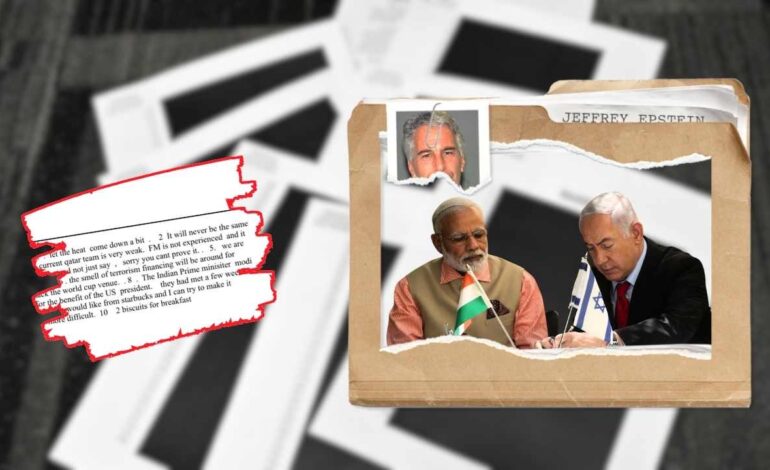
For the record, on July 6, 2017, Epstein allegedly sent an email to a contact in Qatar describing Modi’s recent visit to Israel. Reproduced verbatim from the website of the US Department of Justice, Epstein’s alleged email reads: “The Indian Prime minisiter modi took advice. and danced and sang in israel for the benefit of the US president. they had met a few weeks ago.. IT WORKED.!”
Is this how Indian citizens are expected to find out information about their Prime Minister?

Below is a quick wrap-up of how some newspapers covered the issue and my thoughts as a former editor. (I have kept out party mouthpieces.) The phrase “Journalism of cower-age” is not my coinage. The credit goes to a clever social media user.
THE INDIAN EXPRESS


Edition: Delhi
PM-Epstein report: Page 6
Size: Single column
Position: Middle of the page
Relative prominence: Smallest single column on the page
Does the report specify what the Epstein file allegedly says about Modi? No. The report mentions “a reference” and “certain claims” but does not share with the reader what the “reference” or “certain claims” are.
Was the same policy followed while reporting other Epstein file entries? No. The same day’s World page (Page 12) has a big splash on the latest Epstein “document dump”, full with pictures and other details. The alleged sex life of Bill Gates is given pride of place in the roster. The after-party that Mira Nair (the headline helpfully gives the detail that she is the “mother of NYC mayor Mamdani” as if he decides which party his mother attends) allegedly went to has a separate story on the page.
JOURNALISM OF COWER-AGE SCORE: 9/10
THE TIMES OF INDIA


Edition: Delhi
Page number: 18
Size: Single column
Position: Top of page
Relative prominence: Top but small single column
Does the report specify what the Epstein file allegedly says about Modi? No. The report mentions “a reference” to Modi and his visit to Israel, under the headline, “Govt trashes ‘Epstein files’ email on Modi”. How The Times of India missed a chance to say “Govt trashes ‘trashy’ Epstein ’email’ is a mystery.”
Was the same policy followed while reporting other Epstein file entries? Ha, ha, ha. Not at all. The Times of India has a Page 1 bylined article, datelined Washington, on the Epstein files but the report focuses on Gates and others (under the headline, “New Epstein files claim Bill Gates caught STD from ‘Russian girls’,” and studiously avoids Modi. The same article continues (again bylined) as the lead story in the Global page (Page number 26) under the headline “Epstein emails have 100s of references to Trump, likely to shake up US politics”. Evidently, the Indian newspaper is more worried about US domestic politics. The paper has a chart on Gates, Richard Branson, Elon Musk, Howard Lutnick, Donald Trump, Andrew Mountbatten-Windsor and Steve Tisch but not on the purported content of the email referring to “modi”. The paper lists the granular references against “political and business elites” in spite of mentioning in the very first paragraph of the Page 1 report that some of the references are “lurid and unsubstantiated”.
JOURNALISM OF COWER-AGE SCORE: 9.5/10
THE NEW INDIAN EXPRESS
Edition: Thiruvananthapuram
PM-Epstein report: 0 (Could not readily find the report but I did not check the sports page)
Was the same policy followed while reporting other Epstein file entries? No. The same day’s World page (Page 9) has the following as the main headline: “Epstein’s partner presented girl to Trump, newly-released files reveal”. Gates gets top billing here too.
TELLING CLUE: The newspaper has a very important piece of news on Page 8: “Newspaper reading made mandatory for students in 800 skill centres in UP”. The eagerness to protect students from the “trashy rumination by a convicted criminal” (the Indian foreign ministry’s description of the alleged Epstein entry on the PM) must have made the newspaper drop the report. If so, a question pops up: shouldn’t the students be protected from such details as “Epstein’s partner presented girl to Trump”?
JOURNALISM OF COWER-AGE SCORE: 10/10
THE TELEGRAPH

Edition: Calcutta
PM-Epstein report: Page 2
Size: Three columns
Position: Second deck
Relative prominence: Prominent but for some reason, the alleged sex life of Bill Gates is given top-of-the-page play than the purported reference to the PM, Trump and Israel.
Does the report specify what the Epstein file allegedly says about Modi? Yes. The report quotes verbatim from the purported Epstein file, under the headline “Centre rubbishes Modi mention in mail”.
JOURNALISM OF COWER-AGE SCORE: 5/10
THE HINDU

Edition: Delhi
PM-Epstein report: Page 9
Size: Long double column
Position: Below the fold
Relative prominence: Prominent but shoved down the page
Does the report specify what the Epstein file allegedly says about Modi? Yes. The Hindu has carried the longest and fairly comprehensive report on the issue, compared with the other newspapers I saw.
JOURNALISM OF COWER-AGE SCORE: 4.5/10
MALAYALA MANORAMA

Edition: Thiruvananthapuram
PM-Epstein report: Page 9
Size: Three columns
Position: Top of the page
Relative prominence: Prominent but light font headline, blue background and colourful standalone picture below overshadow the report. But the newspaper is the only one I saw that says in the headline the news first and then the reaction: “Epstein file has a Modi reference; Centre dismissive”.
Does the report specify what the Epstein file allegedly says about Modi? Yes. It is mentioned clearly
JOURNALISM OF COWER-AGE SCORE: 6/10
MATHRUBHUMI

Edition: Thiruvananthapuram
PM-Epstein report: Page 9
Size: Five columns
Position: Below the fold
Relative prominence: Somewhat prominent because of the double-deck headline in red.
Does the report specify what the Epstein file allegedly says about Modi? Yes, it is mentioned clearly. But the headline is a bit confusing. The headline says “Epstein files: Centre denies allegation that Modi’s name is mentioned”. As far as I can understand from the statement of the external affairs ministry, it has not explicitly denied that Modi is mentioned in the email (neither has it confirmed but chooses the double-edged phrase “so-called Epstein files”. What the ministry has denied is the veracity of parts of the claims in the email, as far as I can understand.
JOURNALISM OF COWER-AGE SCORE: 6.5/10
WHAT AN EDITOR SHOULD DO (According to me)
To be sure, Epstein is a jerk whose claims should be taken with a huge pinch of salt. But a newspaper cannot dismiss any information without trying to verify it.
A newspaper’s principal role is to inform its readers. An editor has the final say on which news to carry and where to carry it but they have no business spiking any information concerning the Prime Minister or any elected representative or public figure if it involves public interest.
If an editor is not sure of the authenticity and is unable to verify it, they should see if the information is free of filthy language and indecent comments. If so, the editor should share it with the reader with an admission that the authenticity could not be verified. Even if the information has bad language, it should either be paraphrased or the nature of the information made clear and then published if it involves public interest. India’s foreign policy definitely involves public interest. Also, if the information turns out to be false later, it can be displayed prominently. Public figures always get a second chance. In any case, the newspaper is not levelling the allegation but merely reporting what has been released in another country under intense public pressure, survivor advocacy and binding legislation.
As a measure of extreme caution, the editor can get the information vetted to see if some of the specifics could be verified. From Epstein’s mail, the first question that pops up is: did Modi visit Israel around the time the purported email was said to have been sent? In short, did Modi visit Israel around July 6, 2017? Yes, Modi did visit Israel from July 4 to 6, 2017. This is what the Ministry of External Affairs had said on July 05, 2017: “Marking the 25th anniversary of the establishment of diplomatic relations between the two countries, Prime Minister Narendra Modi of India visited Israel from 4-6 July 2017 at the invitation of Prime Minister Benjamin Netanyahu of Israel. This historic first-ever visit by an Indian Prime Minister to Israel solidified the enduring friendship between their peoples and raised the bilateral relationship to that of a strategic partnership.”
Second question: After referring to Modi and the US President, the purported email says “they had met a few weeks ago”. Did Modi and Trump meet a few weeks before? Yes. On June 21, 2017, Brookings, the US-based think tank, had announced: “Three years into his term, Indian Prime Minister Narendra Modi will visit two countries with which India has close partnerships. He will return to Washington on June 25-26, this time for his inaugural meeting with President Trump. Following that, he will travel to Israel on July 5-6 for the first-ever visit by an Indian premier. For Israel, the growing relationship with India is part of a wide-ranging effort to deepen its relationship with major Asian powers including India, China, and Japan. On June 21, The India Project and the Center for Middle East Policy at Brookings hosted an event, with one panel each focused on India’s relationship with the United States and Israel.” In focus during Prime Minister Narendra Modi’s visit to the U.S. was his establishment of a personal equation with U.S. President Donald Trump, the Hindu Net desk reported on June 27, 2017.
Third and million-dollar question: Did Modi dance and sing in Israel? We don’t know. We don’t even know if the email writer used the phrase figuratively or literally. What we know is that Modi and Netanyahu hit it off very well. This is what NDTV reported — rich in details of statecraft — on July 6, 2017: “Prime Minister Narendra Modi and his Israeli counterpart Benjamin Netanyahu today took a stroll on the beach, their natural warmth and chemistry on full display. The two prime ministers hitched up their trousers and waded barefoot into the surf together at Olga beach in northern Israel. They had gone to the beach to see a demonstration of a mobile water desalination unit. Later, they drove together in the mobile water desalination unit — which looked like a dune buggy – and were seen sipping samples of water from wine glasses, even raising a toast.” Most readers are certain to remember the beach pictures so vividly described in the NDTV report. (This was five years before the Adanis gained control of NDTV.)

With the information available so far and the subsequent as well as persistent claims by Trump and the silence by Modi, an editor has only one option: the information must be published but without being judgemental and without casting aspersions on the Prime Minister or how his foreign policy is conducted. The responsibility of the media to inform the public assumes paramount importance here. Besides, withholding information can sometimes harm the person or organisation a newspaper could be seeking to protect. In the absence of clarity, readers may speculate and imagine the worst possible scenarios that are far more damaging than what may have actually taken place. Maximum transparency possible, provided the information does not affect public order or harm national security and is within the limits of decency, is always the best policy.
Then the editor faces a big question: Should the purported claims of a beast like Epstein be published? The answer does not lie in the character of Epstein but in the question why Epstein mentioned Modi. Then other purported mails come into play, including those involving Anil Ambani. Then comes the very BIG question: Were the Indians dealing with Epstein even after his atrocities were known? The Wire reports: “The most significant communications occurred in May 2019 – barely six weeks before Epstein’s arrest on federal charges of trafficking underage girls – as India’s general election results were being counted.” Considering these details, my answer is: Yes, the purported contents of the email must be published.
The next question is how to play it. Almost every newspaper, except a party mouthpiece, I saw wrote the story as a denial. None of the reports began with the news: that the Prime Minister’s name figured in the purported mail and what the mail said. Most news reports chose to begin with the denial, regardless of the fact that they had not reported the email content earlier. Some editors try to justify this by saying TV has already shown the news and the print wants to take it forward. Then why do reports on the speeches of Modi and Amit Shah attacking the Opposition (which are shown ad nauseam on TV) begin with the same attack in the newspapers the next day and not with the Opposition’s reaction? The uniform manner in which most newspapers have begun the story with the external affairs ministry’s denial raises the question whether it was choreographed or whether the default response from the media now is to highlight the official response.
Of course, Epstein was among the worst scum on earth, whose utterances have no ring of credibility — a factor that must have influenced the decision of the editors who decided to bury the news. But what’s sauce for the goose is sauce for the gander too. Why, then, did some of these newspapers publish Epstein’s claims against Gates and others in detail and prominently in spite of them issuing denials? Why didn’t these newspapers begin the story with Gates’s denial, instead of Epstein’s lurid claims?
Of course, editors can and should decide what they should highlight in a story. The Wire led with the Ambani angle, which is of far greater significance and which ties into the Modi reference. In a brilliant report by Devirupa Mitra and with the headline “Epstein Messages Reveal Anil Ambani Using Sex Offender’s Access to Pitch Modi’s Agenda With Trump”, The Wire nails it. The Wire also reported that “Newly released email exchanges between Bharatiya Janata Party leader Hardeep Puri and Jeffrey Epstein – though confined to business networking and investment discussions – cast doubt on the BJP’s earlier claim that Puri’s appearance in a message from Epstein amounted to little more than casual “name-dropping”. I could not readily see this information in the legacy newspapers I buy. AND THE WIRE IS FREE, UNLIKE THE LUMBERING LEGACY GIANTS WHO CHARGE MONEY BUT WITHHOLDS INFORMATION OR UNDERPLAYS IT. The point is: highlight what you want but do not begin with a denial and do report the full information as long as it is printable.
On the question of placement in newspapers, was this not a blind Page 1 report? How am I affected if “Bill Gates caught STD” or not? Should I not be bothered more about India’s foreign policy than Gates’s alleged medical affliction? Let alone Page 1, the Modi reference report has not made the main slot even in inside pages in the English legacy newspapers I buy. Hindustan Times has a Page 1 mention in a small box at the bottom of the page but that too focuses on the government denial.
The British press can be accused of many things. But when it comes to accountability, the British papers sometimes do what needs to be done. I leave you with the front pages of three “quality”, not tabloid, British newspapers although the revelations involving the former prince are not comparable with the entries linked to Indians so far.

Author’s Note: Epstein’s alleged email has spelling mistakes and, like many rich people, he did not believe in capital letters. I have reproduced the quote exactly as it appears on the US DoJ site.
About Author
Courtesy: The AIDEM