
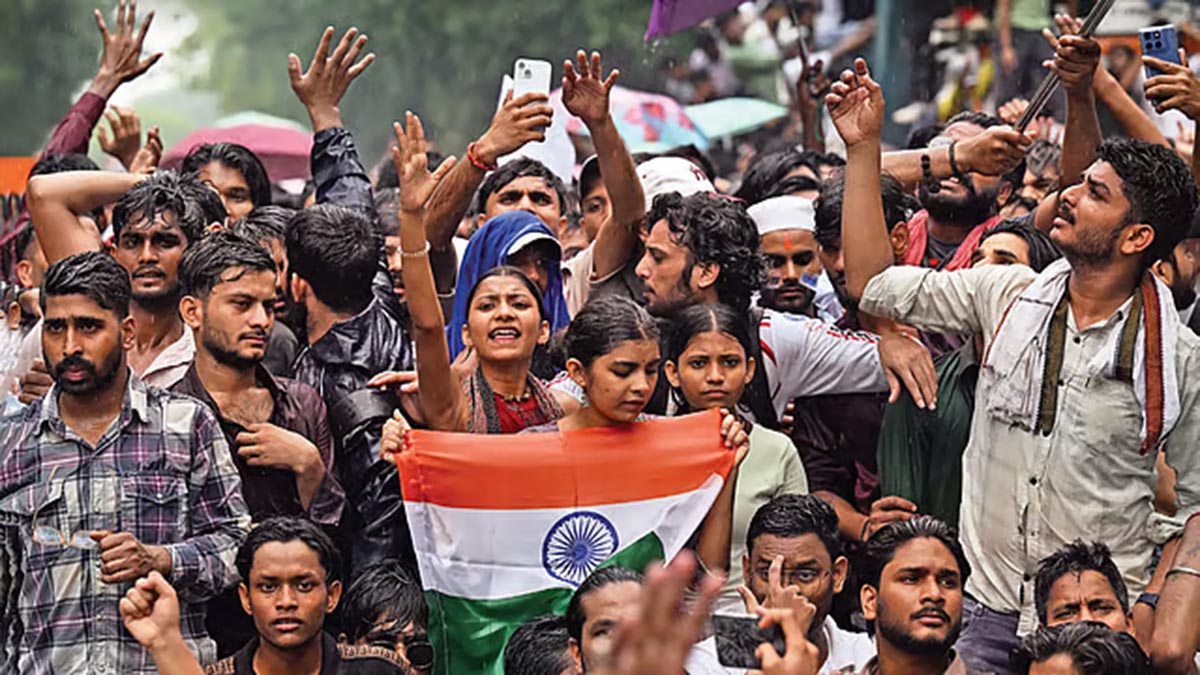
India is witnessing an unexpected turn of events. A generation often dismissed as distracted, entitled, or politically apathetic has demonstrated remarkable courage, discipline, and democratic maturity. In doing so, it has reminded the country that democracy is not sustained by institutions alone but by citizens willing to defend it.
This shift is exhilarating and energising for those who have long felt some quiet desperation that things may not change. The easy camaraderie across class, caste, gender, sexual orientation, language, geography, physical ability had people observing, struck in awe. What many of us articulated from podiums, through media and books is now being demonstrated in the streets. This is not to say that all that ground work is irrelevant. It probably provided a backdrop for the scale of the current movement. The fact that the Union and state governments have been forced onto the back foot is impressive. This is especially because these same bodies, along with their supporting structures – the governors, judiciary, media and bureaucrats have been largely tone deaf. Their disproportionate abuse of power had the chilling effect of silencing many voices – individuals who had too much to lose when the full strength of the state power was turned upon them.
The honourable chief Justice of India would probably for the first time have felt that words have consequences. When one thinks about the number of people in power who have used inflammatory casteist, sexist and anti-minority language without any fear of consequences, one feels that this is exactly the kind of movement that the country needed – irreverential, inordinately humorous and witty and refusing to back down. In spite of the unacceptable level of violence against the students, their spirits shone through and that is what makes this movement exactly what the country needed.
The movement was sparked by allegations of irregularities in the NEET-UG 2024 examination, which led students across the country to demand transparency, accountability, and reforms in the examination process. The controversy eventually reached the Supreme Court, which heard multiple petitions challenging the conduct of the examination while directing investigations into allegations of malpractice. The Union Government subsequently entrusted the investigation into the paper leak allegations to the Central Bureau of Investigation (CBI), underscoring the seriousness of the controversy.
Students demonstrated across numerous states, with protests organised both on university campuses and in major cities, amplified through social media and supported by parents, teachers, and sections of civil society.
Perhaps the movement’s greatest lesson was its clarity of purpose. The students remained overwhelmingly non-violent despite facing lathi charges, water cannons, tear gas, and allegations of sexual assault. Their discipline became one of the movement’s greatest strengths. They refused to be distracted by peripheral issues, remaining focused on a limited set of clear and achievable demands.
No popular movement is beyond criticism, and this one is no exception. Every mass mobilisation carries risks: co-option by political interests, internal divisions, misinformation, or the influence of powerful corporate and political actors. Those dangers must always be recognised. Yet one of this movement’s greatest strengths was that it drew support from many quarters without becoming the project of any single political party. That independence gave it both legitimacy and resilience.
The movement also built upon earlier struggles. The farmers’ protests demonstrated that sustained, peaceful resistance could withstand enormous political pressure. That legacy provided confidence to a new generation of protesters and reminded those in power that coercion does not always produce submission. Each successful act of peaceful resistance strengthens democratic culture and encourages others to participate in public life. Six months before that, youth and women across generations, all hailing from India’s largest minority group had stunned us with their peaceful sit-ins and protests challenging the anti-constitutional amendments to Citizenship (Amendment) Act, 2019 and the impending National Register of Citizens (NRC). Analyses and reports of both these historic mobilisations may be read, here, here, here and here.
There are some lessons from this movement that needs to be recognised.
The students continued to remain largely non-violent in spite of lathi charges, water cannons, tear gas, and sexual assaults. Their equanimity is commendable.
They had select demands and they stuck to these doggedly. There was no back and forth negotiating and nit picking. The focus on doable demands which were completely rational to anyone was important. Rather than one insensitive minister being replaced by possibly another, the movement created accountability mechanisms that have long been forgotten in the country irrespective of the party in power. This movement for accountability will raise the bar not only the current government but also the Opposition and anyone considering a political career. That, in itself, is a huge victory for the country. The message is that serious violations will face consequences.
The farmers, to their credit, had paved the way and their presence, along with other movements, lent an air of impenetrability to the movement. It said that violence against the students would bring more, not less resistance. The memory of the farmers protests would still linger in the memory of the current political dispensation and each movement that they fail to disrupt with their usual cheap tactics is like disciplining a recalcitrant child.
This movement gives enormous sense of hope to the apparently depressed civil society organisations.
One is that there is always a need for a vibrant civil society who hold power. Depending on the nature of autocracy of the government, the losses and struggles are more, but in the absence of that struggle, there is zero hope.
A senior doctor told me at the peak of government flexing its strong arm against citizens, that some of us have to hold the fort. Now those few people – the small media houses, the YouTubers, the pockets of resistance will have the army of youth asking questions. It is good lesson when one is feeling hopeless about the way forward.
We need to consider this as a very positive and hopeful beginning. The context will not be drastically changed by the resignation of education minister. There are many more systemic changes needed in our democratic country. But the underlying message is change is possible!
As Dr. BR Ambedkar said “Political democracy cannot last unless there lies at the base of it social democracy.”
The author is Secretary, Social Justice and Ecology Secretariat, New Delhi.
Related:
The Supreme Court’s Uneasy Middle Path on Protest Policing
The Republic Speaks Back: How Student Power Reminded Authority of Its Limits