
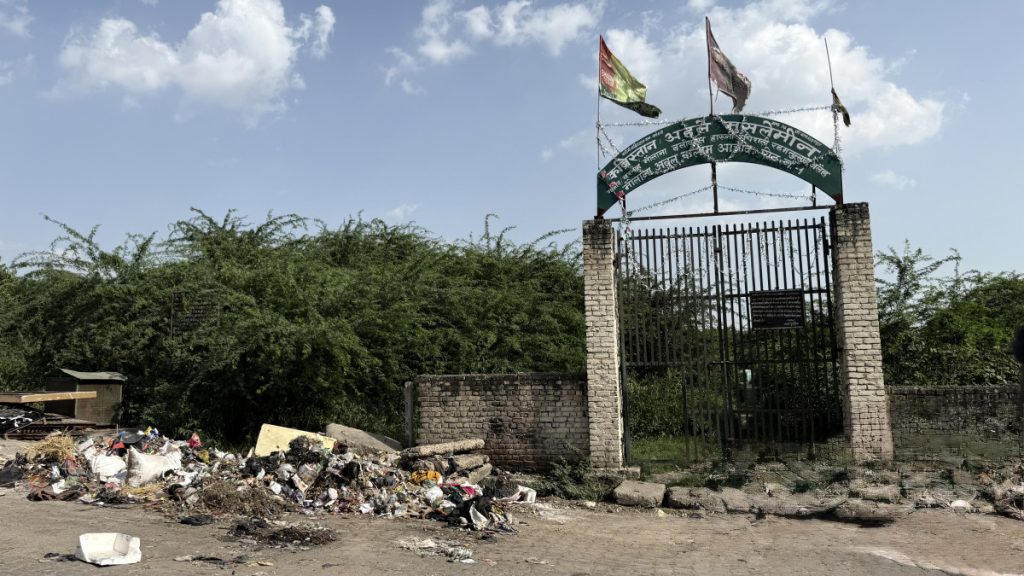
The destruction of graves inside a century-old Muslim cemetery in Mathura is not merely a story about a botched demolition operation. Nor is it simply a question of inadequate compensation. At its core, the controversy raises a deeper and more unsettling question: what happens when the language of administration and compensation is used to quantify a harm that is fundamentally incapable of valuation?
As reported by The Wire, on April 26, 2026, residents of Manoharpura in Mathura discovered that graves inside the Ahl-e-Muslimeen Kabristan had allegedly been damaged during a demolition exercise carried out with JCB machines working under the supervision of local authorities. Burial shrouds were exposed, graves were uprooted and skeletal remains reportedly became visible. Families arrived to find the resting places of parents, grandparents and relatives disturbed, turning what should have been a protected space of mourning and remembrance into a site of anguish and outrage.
The cemetery is not an informal burial ground. According to documents cited by The Wire, the Ahl-e-Muslimeen Kabristan is a gazetted waqf property dating back to 1909 and recognised by the Uttar Pradesh Sunni Central Waqf Board. For generations, it has served as the burial ground for local Muslim families. Residents allege that nine graves were damaged, while six trees, boundary structures, fencing pillars and other parts of the cemetery were also destroyed during the operation.
Yet what transformed the incident from a local controversy into a matter of wider constitutional concern was not only the damage itself, but the state’s response to it.
Documents reviewed by The Wire reportedly show that the Mathura-Vrindavan Municipal Corporation formally acknowledged that approximately nine graves had been damaged. In a communication issued following complaints lodged through Uttar Pradesh’s Integrated Grievance Redressal System (IGRS), authorities reportedly directed compensation at the rate of Rs 100 per grave, valuing the destruction of nine graves at Rs 900. Separate assessments were conducted for damaged trees and fencing structures, resulting in compensation calculations for those losses as well.
For many residents, the issue was not merely that the amount was small. Rather, it was the very act of assigning a bureaucratic value to disturbed graves that appeared shocking. The controversy has therefore become less about the amount of compensation and more about what the calculation itself represents.
The question repeatedly raised by affected families is a simple one: what is the value of a grave?
The significance of that question becomes clearer when one considers the unique nature of burial grounds. A cemetery is not merely land. Nor is it simply a collection of physical structures. Burial grounds occupy a distinctive place within every society because they exist at the intersection of memory, religion, family history and human dignity. They are spaces where communities maintain continuity with previous generations and where the living continue to honour those who have passed away.
Every grave represents a life lived and relationships that continue beyond death. A parent, a sibling, a spouse, a grandparent or a child may be buried there. The disturbance of a grave therefore affects far more than physical property. It disrupts a family’s connection to the deceased and a community’s relationship with its own history.
This is why societies across cultures and faith traditions have historically treated the disturbance of burial grounds as a particularly serious wrong. Respect for the dead has long been regarded as one of the most basic markers of civilisation itself. Even international humanitarian law, which governs armed conflict, contains provisions concerning the respectful treatment of human remains and burial sites. The protection of the dead is recognised as a moral obligation that survives political conflict, territorial disputes and social divisions.
The outrage in Mathura stems from precisely this understanding. Residents are not merely complaining about damage to land. They are expressing anguish over what they regard as the desecration of a sacred space and a violation of the dignity of their dead.
The controversy also raises important questions about how law understands compensation.
Compensation in law is often misunderstood as a mechanism for calculating the market value of a loss. In reality, courts routinely award compensation for injuries that are impossible to measure in economic terms. Constitutional courts have awarded compensation for custodial violence, illegal detention, police excesses, violations of fundamental rights, wrongful deaths, emotional suffering and infringements of human dignity.
In such cases, compensation does not place a literal price on liberty, dignity or human suffering. Rather, it serves a broader purpose. It acknowledges wrongdoing, recognises injury, affirms the dignity of the victim and signals the state’s acceptance of responsibility.
The Supreme Court has repeatedly recognised this principle. Beginning with landmark cases such as Rudul Sah v. State of Bihar, Nilabati Behera v. State of Orissa and subsequent constitutional tort jurisprudence, Indian courts have held that monetary compensation may be awarded when fundamental rights are violated. Such compensation is not intended to erase the injury suffered. Instead, it functions as public recognition that a serious constitutional wrong has occurred.
Viewed through this lens, the Mathura episode appears particularly troubling.
The official response reportedly treated damaged graves within the same administrative framework used to calculate losses relating to fencing structures, landscaping and trees. Yet a grave is not municipal infrastructure. It is not an asset whose value can be determined through replacement cost. It is the resting place of a human being and occupies a unique position within constitutional, religious and social life.
The controversy therefore exposes the limitations of administrative approaches to certain forms of harm. Some injuries cannot be fully understood through accounting exercises because the injury itself lies not in the physical object damaged but in what that object represents.
The constitutional implications of the incident extend beyond compensation. Article 21 of the Constitution protects the right to life and personal liberty and has been interpreted by courts to include human dignity as one of its central components. Importantly, Indian courts have repeatedly recognised that dignity does not disappear at the moment of death.
Judicial decisions have acknowledged the importance of dignified burial, dignified cremation and respectful treatment of human remains. During the COVID-19 pandemic, courts across the country intervened repeatedly to ensure that even those who had died from infectious diseases were accorded respectful last rites. The underlying principle was clear: human dignity survives death. The treatment of the dead reflects the constitutional values of the living.
Seen from this perspective, the alleged disturbance of graves at the Ahl-e-Muslimeen Kabristan engages concerns that extend beyond municipal negligence. It raises questions about whether public authorities adequately recognised the nature of the harm involved. If the disturbance of graves implicates dignity, memory and religious identity, then reducing the injury to a compensation calculation risk obscuring the true nature of the wrong.
The controversy also engages questions of religious freedom. Burial practices are integral components of religious life. Cemeteries and graveyards are not ordinary public spaces but sacred sites through which communities discharge religious obligations, preserve ancestral connections and maintain collective memory. Their protection is therefore closely connected to the constitutional guarantee of religious freedom under Article 25.
This concern becomes particularly significant where the cemetery in question is a recognised waqf property. Waqf institutions occupy a protected legal status and are intended to preserve religious and charitable assets for the benefit of the community. The fact that the Ahl-e-Muslimeen Kabristan is a notified waqf property raises additional questions regarding the safeguards that existed to protect the site and the procedures followed before demolition work was undertaken.
The incident acquires further significance when viewed against the broader political and social context of Mathura. As The Wire notes, the district has witnessed continuing disputes concerning Muslim religious sites, waqf properties, demolition drives affecting Muslim localities, campaigns targeting Muslim-owned businesses and politically charged litigation surrounding the Shahi Idgah mosque. Local residents have also raised concerns regarding encroachments around the cemetery, the establishment of a garbage collection point near its entrance and previous attempts to alter the character of the land.
Whether these concerns are accepted or contested, they form the backdrop against which the graveyard controversy is being interpreted by the affected community.
This context matters because institutions do not operate in a vacuum. Administrative actions acquire social meaning through historical experience. For many local Muslims, the disturbance of graves does not appear as an isolated bureaucratic mistake. Rather, it is seen as part of a broader pattern in which Muslim spaces—homes, businesses, places of worship and now burial grounds—have increasingly become sites of contestation and intervention.
This is what transforms the story from an administrative controversy into a constitutional one. The issue is not merely whether a contractor made an error or whether compensation was eventually paid. The deeper concern is how institutions respond when sacred spaces belonging to a minority community are damaged. Do they treat the incident as a technical mistake requiring reimbursement, or as a serious violation demanding accountability, restoration and recognition of the injury inflicted?
The documents cited by The Wire establish a paper trail showing that authorities acknowledged the damage and directed compensation. But acknowledgment is not accountability. Compensation is not justice.
A cheque may close an administrative file, but it does not answer the central questions raised by the episode. Why was a legally recognised cemetery disturbed? Who authorised the operation? What safeguards existed to protect burial sites? Was the legal status of the cemetery verified beforehand? Were any officials held responsible? Will restoration measures be undertaken? And what remedies are available when the dignity of the dead is violated?
Until those questions are answered, the controversy surrounding the Ahl-e-Muslimeen Kabristan will continue to resonate far beyond the boundaries of a single graveyard. Ultimately, the most disturbing aspect of the Mathura incident may be the message that many residents believe it conveys. The issue is not simply that graves were damaged. It is that the destruction of a sacred burial ground appears to have been processed through the machinery of administration as though it were no different from a damaged fence or uprooted tree. In doing so, the state risks transforming a question of dignity into a question of accounting.
And that is why the controversy has become about far more than nine damaged graves. It forces a larger reckoning with how law, administration and public institutions understand harm itself. Some injuries can be compensated. Others can only be acknowledged. The disturbance of the dead belongs firmly in the latter category.
Related:
Muslim group switches sect, Kerala HC upholds their rights to prayer and burial
Segregated burial grounds, a violation of the Constitution: Madras High Court
Christians not being allowed burials, forced to cremate in Mumbai?
In a Heartwarming Gesture, Hindu Family Donates Land for Muslim Burial Ground in Assam