
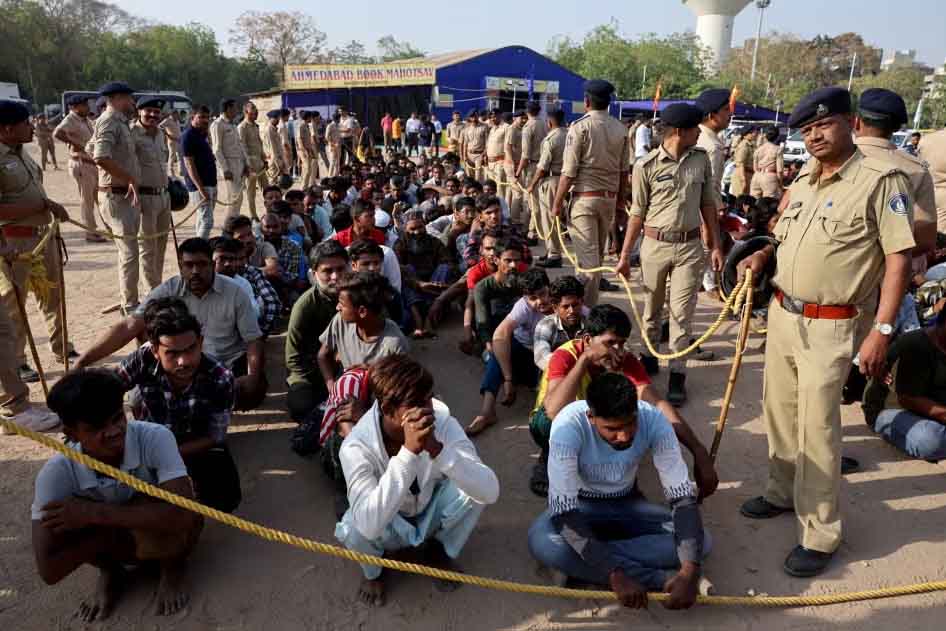
The Bharatiya Janata Party’s (BJP) return to power in Assam and its historic electoral breakthrough in West Bengal have transformed a decades-old political campaign against alleged illegal migration from Bangladesh into one of the most extensive citizenship and deportation drives seen in recent years. Across these Border States, thousands of people have been detained, hundreds have reportedly been deported, detention infrastructure is rapidly expanding, and a new national policy framework seeks to institutionalise the identification, confinement and removal of alleged undocumented migrants.
The government presents the exercise as a necessary response to illegal immigration, demographic change and national security concerns. Yet mounting evidence from court proceedings, media investigations, government directives and testimonies from affected families raises a more troubling picture: one in which due process protections appear increasingly fragile, citizenship verification procedures are often opaque, and Bengali-speaking Muslims bear the overwhelming burden of suspicion.
Detailed report may be read here.
At the heart of the controversy, lies a fundamental constitutional question: can the Indian state pursue such detention and immigration enforcement while bypassing the procedural safeguards that protect individuals from arbitrary detention, wrongful deportation and statelessness? Two, without this due process of either established legal norms or procedures not enquiries/investigations into who these illegal immigrants are, is such action not arbitrary and without foundation?
The missing data and the transparency deficit
Perhaps the most troubling aspect of the current deportation drive is not merely the scale of the exercise but the extraordinary lack of transparency surrounding it. Across Assam, West Bengal, Gujarat and other states, governments have announced deportations, detention drives and large-scale verification exercises. Yet even today, there is no publicly available dataset identifying who has been classified as an undocumented migrant, from which districts they were picked up, what evidence was relied upon, whether nationality was independently verified, how many individuals challenged those determinations, how many continue to remain in detention centres, and how many have ultimately been deported.
This absence of information is particularly striking because the consequences of these decisions are so severe. Deportation is among the most coercive powers exercised by the state. It can separate families, extinguish livelihoods, result in prolonged detention and, in some cases, leave individuals stranded in a country they insist is not their own. Yet the public is being asked to accept the legitimacy of the process without access to even the most basic information about how it is being carried out.
The opacity is all the more difficult to justify because the Union governments own deportation policy appears to contemplate extensive record keeping and reporting requirements. The policy submitted by the Ministry of Home Affairs before the Supreme Court requires state governments to maintain records of individuals handed over for deportation, submit mandatory reports to the Union government, and provides that the Bureau of Immigration shall publish information relating to deported Bangladeshi nationals and Rohingyas on a public portal for verification purposes.
Yet little of this information is publicly accessible. Speaking to Al Jazeera, civil rights activist and CJP Secretary Teesta Setalvad argued that the present campaign appears to be driven more by political rhetoric than publicly available evidence. “Even today the authorities have not made available exactly who, which families, from which locations have been identified as illegal immigrants, on what basis and assessment and then sent back,” she said. “There is also an element of targeting specific sections, particular communities.”
Her criticism points to a fundamental problem: In the absence of publicly available data, independent scrutiny becomes nearly impossible. It is impossible to assess whether those being detained and deported are in fact undocumented migrants, whether particular communities are being disproportionately targeted, whether established procedures are being followed, or whether wrongful deportations are taking place.
The demand for transparency is therefore not a procedural technicality. It lies at the heart of democratic accountability. If governments are confident that deportations are being carried out lawfully, after proper verification and in accordance with due process, then there is a compelling public interest in releasing comprehensive data regarding those detained, those housed in holding centres, those whose nationality has been verified, and those who have ultimately been deported.
Until such information is made available, one of the most far-reaching citizenship and deportation exercises in recent Indian history will continue to operate largely beyond meaningful public scrutiny.
From political slogan to state policy
For decades, the BJP has built its political narrative in eastern India around the issue of “illegal infiltration” from Bangladesh. The party has repeatedly argued that large-scale migration has altered the demographic composition of border states, strained public resources and created security vulnerabilities.
The issue has occupied a central place in BJP campaigns in Assam, West Bengal and Tripura. Senior BJP leaders, including Union Home Minister Amit Shah, have frequently described undocumented migrants from Bangladesh as a threat to national security and demographic stability. During previous election campaigns, Shah famously referred to illegal migrants as “termites“, a phrase that drew widespread criticism from civil society groups and human rights organisations. Report in The Hindu.
Following the BJP’s victory in West Bengal, these political commitments quickly evolved into administrative action. Chief Minister Suvendu Adhikari announced the implementation of a “detect, delete and deport” framework under which individuals identified as illegal migrants would be detained by state authorities and transferred directly to the Border Security Force (BSF) for deportation, as per Hindustan Times. The announcement was accompanied by instructions to establish holding centres across districts and create a streamlined mechanism for identifying and removing alleged infiltrators. What was once campaign rhetoric had become state policy.
The creation of a national deportation architecture
The developments in West Bengal are not occurring in isolation. According to documents reported by The Hindu, the Union Ministry of Home Affairs has formulated a comprehensive deportation policy requiring states to establish district-level special task forces for the identification, detention and deportation of alleged illegal migrants from Bangladesh and Myanmar. However, before the Supreme Court of India, in the ongoing Rajubala Das v. Union of India case, the deportation policy submitted before the Courts hays down more tested procedures. The same has been explained below.
The policy directs states to:
- Create dedicated holding centres or camps for undocumented migrants awaiting deportation.
- Establish a time-bound mechanism for identification and nationality verification.
- Upload biometric information and demographic data onto the Foreigners Identification Portal.
- Cancel government-issued identity documents obtained by individuals determined to be illegal migrants.
- Maintain monthly reports regarding foreigners who are untraceable, detained or awaiting deportation.
- Coordinate with central agencies to facilitate removals.
The guidelines envision a nationwide infrastructure capable of processing large numbers of suspected migrants. Holding centres are to be enclosed by ten-foot boundary walls and barbed-wire fencing. Detainees are to remain confined pending verification of nationality and completion of deportation procedures.
Although the policy states that these facilities should provide humane living conditions, medical care, educational facilities for children, communication access and recreational space, rights groups argue that the rapid expansion of detention infrastructure signals a shift towards normalising large-scale administrative detention.
A policy contradiction at the heart of the deportation drive
One of the most striking aspects of the current deportation campaign is the apparent tension between the procedures explained above and the deportation framework that the Union Ministry of Home Affairs itself placed on record before the Supreme Court.
In the Rajubala Das v. Union of India proceedings before the Supreme Court, the MHA submitted an affidavit setting out a detailed deportation policy governing the treatment of alleged undocumented Bangladeshi nationals and Rohingyas. That policy envisages a structured process involving coordination between state governments, the Ministry of Home Affairs, the Ministry of External Affairs, foreign missions and designated border-guarding forces. Crucially, it recognises that nationality cannot be assumed unilaterally and that nationality verification is a necessary component of the deportation process.
The policy specifically provides that where an alleged undocumented Bangladeshi national or Rohingya is arrested, their details are to be furnished to the Ministry of External Affairs so that the matter can be taken up with the Bangladesh High Commission or the Myanmar Embassy for nationality verification. The stated purpose is to enable the foreign government concerned to process and verify the individual’s nationality before deportation is carried out.
The same policy also requires state governments to maintain records of all individuals handed over for deportation and submit mandatory monthly reports to the Ministry of Home Affairs. It further provides that the Bureau of Immigration shall publish a list of deported Bangladeshi nationals and Rohingyas on a public portal for verification purposes.
This raises a serious question: If the deportation policy submitted before the Supreme Court contemplates nationality verification through diplomatic channels, maintenance of detailed records, mandatory reporting and publication of deportation data, how do these safeguards square with reports of alleged pushbacks, summary removals and immediate send-backs at the border?
The question becomes even more pressing in light of report that Bangladeshi and Myanmar nationals intercepted at land or maritime borders may be “immediately sent back” after their biometrics are recorded. The apparent gap between the procedures described before the Supreme Court and practices now being reported on the ground deserves far greater public scrutiny.
Detailed report on the Rajubala case may be read here.
Holding centres become operational
The practical implementation of this framework is already underway. Malda became the first district in West Bengal to operationalise a holding centre under the new policy. The facility initially housed nine individuals identified as suspected Bangladeshi nationals, including women and children.
Officials, as per The Indian Express, described the centre as a temporary facility where detainees would remain while their nationality and immigration status were verified.
However, rights advocates point out that detention itself can become punitive when individuals are confined before citizenship disputes are conclusively resolved. This concern is especially significant in border regions where documentation is often incomplete, where migration has historically occurred across fluid borders, and where linguistic and cultural similarities between Indians and Bangladeshis complicate nationality determinations.
West Bengal
West Bengal is the epicentre of the current drive. According to Chief Minister Suvendu Adhikari, the state has already deported 4,800 alleged undocumented Bangladeshi migrants through newly established holding centres in border districts. Another 836 people were reportedly being held awaiting deportation as of early June 2026, as per The Times of India.
The government has also established an expanding network of detention facilities. Initial reports indicated that 11 holding centres had been created across the state and were housing at least 335 detainees, while later reports from Malda alone suggested more than 150 detainees had already been transferred there from North 24 Parganas district.
Government officials have presented these numbers as evidence of successful enforcement. However, the figures raise significant questions. If nearly 5,000 people have been removed within weeks of the BJP assuming office, it remains unclear how many cases involved completed nationality verification by Bangladesh, how many individuals received access to legal representation, and how many removals were subject to judicial scrutiny.
Gujarat
The largest publicly reported operation outside eastern India occurred in Gujarat. Under “Operation Delta Hunt”, authorities investigated approximately 6,200 individuals and identified 362 people as alleged illegal Bangladeshi immigrants, as per The Hindu. Of these, 166 were identified in Ahmedabad alone, including women and children. Authorities also stated that investigations into hundreds of additional cases were continuing.
The Gujarat government has further indicated that it intends to prosecute employers and landlords accused of sheltering undocumented migrants.
Assam
Unlike West Bengal and Gujarat, the Assam story is not primarily reflected through new numerical announcements but through litigation. Throughout 2025 and 2026, several habeas corpus petitions before the Gauhati High Court and the Supreme Court challenged alleged “pushback” operations involving Bengali-speaking Muslims who claimed Indian citizenship. The significance of Assam lies not merely in the number of people detained but in the emergence of documented allegations that Indian citizens were wrongly identified as foreigners and transported towards the Bangladesh border.
Citizens for Justice and Peace provides legal aid in some cases, details may be read here, here and here.
The Assam cases effectively became the warning sign for what now may happen on a larger scale in West Bengal.
The May 2025 Assam crisis report may be read here.
National figures
At the national level, according to The Hindu, the Ministry of External Affairs has confirmed that India has asked Bangladesh to verify the nationality of more than 2,860 individuals whom Indian authorities believe to be Bangladeshi nationals residing illegally in India.
Simultaneously, the Union Ministry of Home Affairs has directed states to establish district-level mechanisms for the identification, detention and deportation of alleged undocumented migrants from Bangladesh and Myanmar, suggesting that the campaign is being institutionalised nationwide rather than remaining confined to border states.
The human cost of wrongful deportation
Few cases illustrate the dangers of inadequate verification more clearly than that of Sunali Khatun. Reported extensively by BBC News, Khatun, a Bengali-speaking Muslim woman from West Bengal, was detained in Delhi alongside her husband and young son on suspicion of being an undocumented migrant. Authorities alleged that she lacked proof of lawful residence and initiated deportation proceedings. According to her account, officials failed to properly verify her claim that she was an Indian citizen from West Bengal. She, her husband and child were subsequently transported to Bangladesh. Once there, Bangladeshi authorities treated them as illegal entrants and imprisoned them. The family spent months in detention.
Detailed report on this case may be read here.
Only after intervention by the Supreme Court was Sunali permitted to return to India on humanitarian grounds while her citizenship claims continue to be examined. Her husband remains stranded in Bangladesh. The case exposed the potentially catastrophic consequences of administrative errors in citizenship determination. A mistaken deportation is not simply an immigration decision. It can separate families, result in imprisonment in another country and effectively strip individuals of their nationality.
Due process concerns
The central criticism of the current deportation campaign is not that states lack authority to remove foreign nationals. Every sovereign state possesses the power to regulate immigration and deport individuals who are unlawfully present. The issue instead concerns the process by which such determinations are being made.
Under established principles of administrative fairness and constitutional governance, individuals facing deportation should ordinarily have:
- Notice of the allegations against them.
- Access to documentary evidence.
- An opportunity to challenge adverse findings.
- Legal representation.
- Independent verification of nationality.
- Judicial oversight where fundamental rights are implicated.
The recent practices, however, often fall short of these standards. Reports from Assam and West Bengal suggest that detention frequently precedes verification rather than following it. In several cases, families have alleged that individuals were forced to prove citizenship after already being taken into custody. Such an approach effectively reverses the burden of proof and creates significant risks of wrongful exclusion.
Detailed report on deportation process may be read here.
Religious selectivity and the Citizenship Amendment Act
The controversy is further complicated by the interaction between deportation policy and the Citizenship (Amendment) Act. The CAA provides a pathway to citizenship for Hindus, Sikhs, Buddhists, Jains, Parsis and Christians from Afghanistan, Bangladesh and Pakistan who entered India before the prescribed cut-off date. Muslims are excluded.
Chief Minister Suvendu Adhikari has repeatedly emphasised that communities covered by the CAA will not face action under the deportation framework. Those outside its protection, however, remain vulnerable to detention and deportation. Two individuals entering India under similar circumstances may face radically different legal consequences depending upon their religious identity.
This concern is particularly acute because the overwhelming majority of those targeted by current deportation drives are Bengali-speaking Muslims.
Bangladesh pushes back
The crackdown has also generated significant diplomatic friction. Bangladesh has repeatedly objected to what it describes as attempts by Indian authorities to push individuals across the border without completing formal nationality verification procedures.
As per The Indian Express, Border Guard Bangladesh (BGB) officials have publicly stated that they blocked numerous attempts by Indian authorities to send individuals into Bangladesh without prior verification.
Bangladesh’s Foreign Affairs Adviser, Shama Obaid, has stated that Dhaka has repeatedly communicated its concerns to New Delhi and insisted that existing bilateral mechanisms must be followed. The position of Bangladesh is straightforward: no person should be accepted unless their nationality has first been verified. India officially maintains that deportations occur only through established procedures.
Ministry of External Affairs spokesperson Randhir Jaiswal has stated that India has submitted details of more than 2,860 suspected Bangladeshi nationals to Dhaka for verification. Yet the persistence of Bangladeshi objections suggests continuing disagreements regarding implementation.
The demography committee
The deportation drive is now being supplemented by a broader effort to study demographic change. The Union Government recently established a high-level committee chaired by retired Supreme Court judge Justice Prakash Prabhakar Naolekar to examine demographic shifts allegedly caused by illegal migration and other factors. The committee’s mandate extends beyond research.
It has been tasked with recommending systems for identifying, detaining and deporting undocumented migrants and proposing mechanisms for strengthening border management and population monitoring. Its creation fulfils a commitment made by Prime Minister Narendra Modi and reflects the growing centrality of demographic concerns within government policy.
However, the language surrounding the committee has generated concern. Government statements describe demographic change arising from migration as an “unnatural” phenomenon and a “monumental challenge”. Such framing risks treating entire communities as demographic threats rather than as individuals possessing rights and legal protections.
Detailed report may be read here.
A constitutional test
India unquestionably has the authority to regulate immigration and remove foreign nationals who have entered or remained unlawfully. But citizenship determination is among the most consequential exercises of state power.
A mistaken arrest can be corrected. A mistaken deportation can leave a person stateless, imprisoned in a foreign country or permanently separated from family members. The experiences documented in Assam, the wrongful deportation allegations, Bangladesh’s repeated protests over alleged pushbacks, the establishment of detention infrastructure across West Bengal and the government’s push towards a nationwide deportation architecture collectively point to a deeper concern. The issue is no longer merely immigration enforcement.
It is whether the Indian state can pursue that objective while respecting the constitutional guarantees of fairness, equality and due process. As detention centres multiply, deportations accelerate and citizenship verification becomes increasingly securitised, the challenge confronting India is not simply identifying who belongs. It is ensuring that, in the process of deciding who does not, the state does not abandon the rule of law itself.
Related:
India’s Silent Push-Out: Courts, states, and the deportation of Bengali-Speaking Muslims
SC stays deportation of woman declared foreigner, issues notice on challenge to Gauhati HC Order