
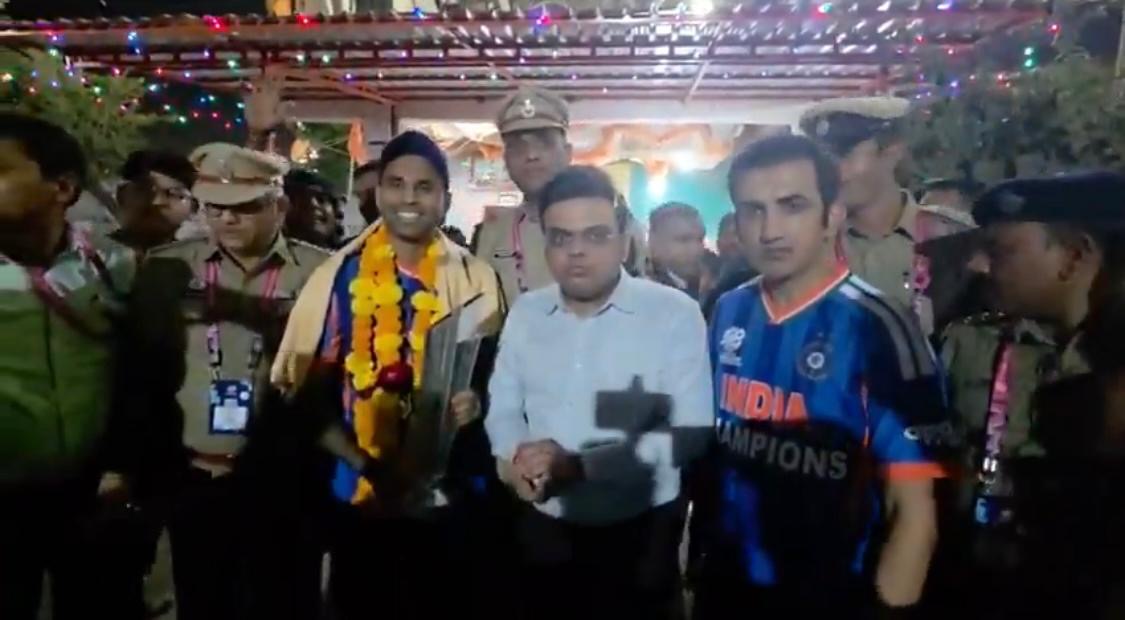
The Indian cricket team comprehensively defeated New Zealand to lift the T20 World Cup on Sunday night in Ahmedabad. As one of the Indian team’s supporters, I felt very glad and proud of our players, especially Sanju Samson and Jasprit Bumrah, who, in my view, were the architects of India’s success. However, the happy mood created by India’s brilliant performance and victory was somewhat dampened the next day when I came across a piece of news.
The media reported that Indian captain Surya Kumar Yadav, head coach Gautam Gambhir, and ICC Chairman Jay Shah visited a Hanuman temple in Ahmedabad soon after the victory celebrations. News agency ANI posted a short video on Twitter in which the skipper is seen entering the temple while holding the trophy.
Surya, along with Gambhir and Shah, went to the temple and offered prayers. The foreheads of Surya and Shah were marked with a tika (a vermilion mark), which Hindu devotees usually apply on their foreheads while visiting a temple. They also received prasad (blessed food) after offering their prayers.
Do Hindus not have the right to visit a temple? If they do, then why am I raising an issue about it? Let me clarify that I am not asking Hindus, Muslims, or people of any faith to give up their religious beliefs. Nor am I suggesting that one should not visit temples or mosques, or refrain from performing religious rituals. In fact, I have often accompanied my family members to temples and even purchased flowers and prasad for them. Just as I have respected their faith, they have never imposed their particular ways of performing rituals upon me. Should not an individual be left alone to reflect on questions of faith?
As a student of political science, I am aware that religious freedom lies at the core of the Indian Constitution. Citizens are free to profess any religion of their choice. The state has no business interfering in the personal beliefs of an individual. The freedom to practise a religion of one’s choice, to give it up and embrace another faith, or not to practise any religion at all, is guaranteed under the Fundamental Rights.
Going by these constitutional provisions, one may argue that Surya, Shah and Gambhir went to the temple as part of their personal faith. Therefore, I may be accused of finding fault with them and, by doing so, revealing my “Hindu-phobic” mind-set.
In my defence, I would first state that criticising the mixing of religion and politics is not an act of being a “Hindu-phobic”. My argument here is not to oppose any religion—be it Hinduism, Islam, Christianity, etc.—but to highlight the threat that religious nationalism and majoritarianism pose to a democratic polity.
Majoritarian politics often hides itself under the garb of nationalism, religiosity, and popular culture. The shrewdness of right-wing leaders lies in their ability to promote religious nationalism through sports, festivals, songs, films, and public celebrations. None other than Dr. B. R. Ambedkar, the messiah of the downtrodden and the Chairman of the Drafting Committee of the Constitution of India, cautioned the people against the danger of religious nationalism when he said: “If Hindu Raj does become a fact, it will, no doubt, be the greatest calamity for this country.”
When cricket, the most popular sport among more than a billion Indians, is used as a tool to promote religious nationalism, one has to take it very seriously. If Surya, Gambhir, and Shah had visited the Hanuman Temple as devotees of Hanuman, they would have gone there simply as devotees and not as celebrities. There would have been no triumphal images been circulated. The difference between ordinary devotees visiting a religious place and celebrities rushing to a temple is significant. Devotees keep their faith at a personal level. Celebrities, however, often perform such acts in the presence of cameras and PR teams, turning a private expression of faith into a public spectacle.
While devotees perform religious rituals as part of their faith and sincerely believe in what they do, celebrities often visit religious places to serve their political interests. They know very well that their interests are best served if they publicly display their acts of performing pooja. Politicians, a smart group among celebrities, often begin their electoral campaigns by visiting temples. They also ensure that their visits to temples are circulated to every household through news stories, photographs, videos, and other media.
In a representative democracy, where governments are often formed through majority votes, there is a strong tendency among politicians to equate the majority religion with the “national” one and even with a “way of life”. In contrast, even a minor display of the religious or cultural symbols of minority communities is often demonised as the rise of “fundamentalism”. Even those who work for the human rights of minorities and show solidarity with their culture—often suppressed under the weight of majoritarianism—are branded as “anti-Hindu.
That is why, there is a strong case to argue that the temple visit of Indian captain, coach and ICC chairman is not simply a matter of personal faith. In fact, it is a case of using popular sport indirectly to reinforce the politics of religious majoritarianism. Since cricketers are one of the biggest icons for the youth of the country, their visit to temple and the viral video afterwards seemed to be carefully planned to equate the national cricket team of secular and democratic republic with “Hindu” India.
The temple visit incident should also not be seen as an isolated event. Over the years, the process of mixing religion and cricket has intensified. Some cricket fans who go to the stadium to cheer for Team India often chant aggressive nationalist slogans and display overt religious symbols. Some of them even pass inappropriate comments on the supporters of the opposing team and sometimes get into fights with them.
Even TV commentators, particularly those in the vernacular broadcasts, frequently use highly jingoistic and sometimes misogynistic idioms. It is beyond comprehension why English commentary tends to remain relatively measured, while vernacular commentaries often turn into acts of shouting and whipping up passion. Worse still, social media influencers, as well as some former cricketers-turned-commentators, do not miss an opportunity to indulge in Pakistan-bashing. While their criticism may be directed at “the poor performance” of Pakistani cricket, their choice of words and tone often ends up feeding communal polarisation.
A quick look at the official jersey of the Indian cricket team reveals the prominent use of the colour, saffron. Is this selection arbitrary, or is it part of a careful design? As a cricket fan, I remember the older Indian jerseys where the tricolour was prominently represented on the T-shirt. Should this shift in the choice of colour be seen as merely random, or does it reflect a deliberate change—and perhaps even a shift in the political equation?
These trends are dangerous at least for two reasons.
First, the instrumental use of cricket to promote religious nationalism has the potential to weaken national unity. We should never forget that the Indian team as well as Indian supporters do not belong to one religion. Those who believe that the temple visit by the Indian captain, coach, and ICC chairman is a normal act should also reflect on how such gestures appear to millions of citizens who belong to different faiths.
Those who think that Surya’s visit to the temple is a “normal” matter should also ask themselves whether they would consider it equally normal if, instead of Surya, a Muslim cricketer had been the captain of India and, after winning the match, had gone straight to a mosque with the trophy and the video of it had gone viral.
Pakistani cricketers are often seen invoking religious expressions while speaking to commentators before or after a match. However, the example of Pakistan may not be appropriate for India, as our Constitution envisions a secular polity. In a multicultural society like India, the state itself has no religion, nor should public institutions be used to promote any particular faith.
Indian cricket is watched by millions of people, and the cricket board should ensure that it maintains the image of a secular institution and remains free from political pressure. As the Chairman of the ICC, Jay Shah carries the hopes of cricket fans around the world. They expect him to work for the promotion of cricket globally and to allow the BCCI to independently carry out the responsibility of managing Indian cricket.
(The author is has recently published book, Muslim Personal Law: Definitions, Sources and Contestations (Manohar, 2026). Email: debatingissues@gmail.com)
Related:
Sikh cricket player dubbed “Khalistani” for dropping catch
Love cricket? Make sure you celebrate only when Team India wins!