
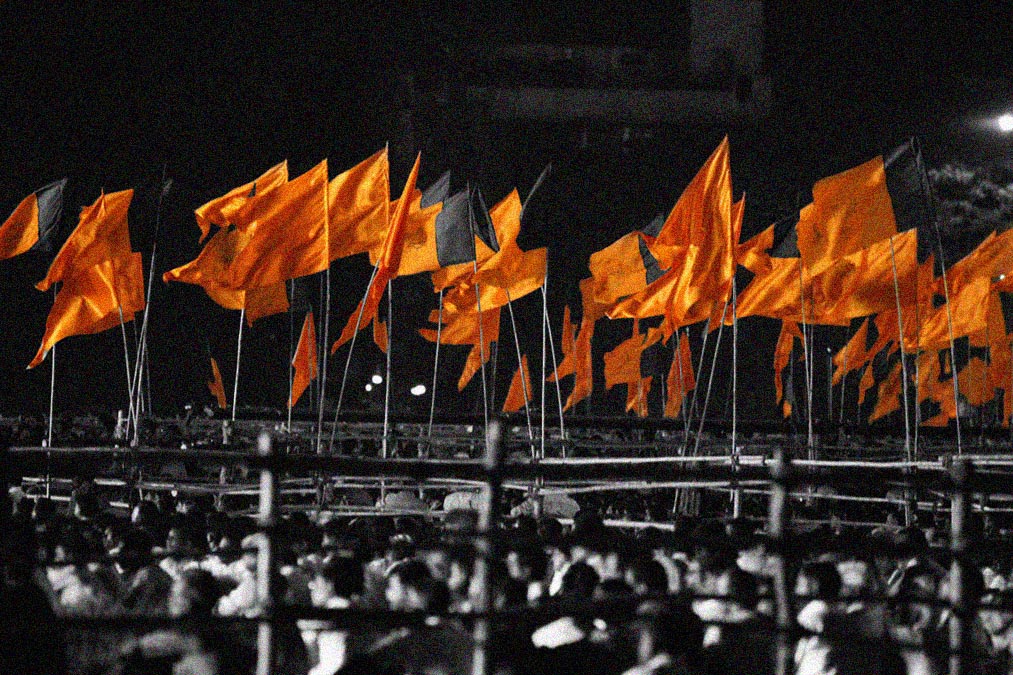
The reactionary ideology of majoritarianism can be found everywhere. It is found in liberal societies. It is found in democracies. Non-democratic societies are also infested with majoritarianism.
The form of “majoritarianism” may vary from one society to another. If there is an authoritarian regime, the manifestation of majoritarianism will be very severe. It will be very crude. It will be very harsh. It will be more reactionary. It may be more brutal in appearance.
But we should never forget this key point: majoritarianism is not only found in non-democratic or illiberal societies. Today, majoritarianism poses a serious threat to democracy.
What is the idea of democracy?
Democracy is understood to be opposed to dictatorship. Democracy is not authoritarianism. Democracy is not monarchy. Democracy is not oligarchy.
This is the definition that is generally accepted by most liberal thinkers.
But Dr. Ambedkar added one important dimension to the idea of democracy and went beyond liberal thinkers. The messiah of the downtrodden said that a true democratic system is one where marginalised community are given opportunities; they are given a space to make laws, and they are in a position to implement policies. In other words, power is shared with the marginalised castes and communities. It is not just the government of the people; it is also government by the people.
If a “democracy” is to be called a democracy, it should not just feel content with holding elections and sending people to legislative assemblies. Unless marginalized communities such as Dalits and Adivasis, and religious minorities such as Muslims, Christians, and Buddhists, among others, are given proper representation, it will not work. If they are not given effective representation, if they are not involved in the process of law-making, and if they are not given a space to implement policies, then that is not democracy.
Dr. Ambedkar has also added another thing: democracy is the system through which we have to bring about social change.
So, in Ambedkar’s view, if society is becoming more and more egalitarian, if inequality is reduced, if marginalised communities are given power and representation, then we can call it a true democracy.
In fact, majoritarianism is the perversion of Dr. Ambedkar’s idea of democracy. While Dr. Ambedkar’s definition of democracy lays stress on effective and proportionate representation and safeguarding minority rights, majoritarianism is the dominance of a particular religious community, caste group, or racial group over the rest of the population.
Under a majoritarian system, a particular caste, a particular religious community, or a particular social group starts believing that they are the “real” citizens of the country. They are the “sons of the soil”. They are the “warrior” race. They are truly “patriotic”, while the rest of the population are “inferior”, “subordinate”, “second-class citizens”, and their culture and their way of life are a “threat” to the nation.
The dominant sections of society, believing in a majoritarian ideology, make efforts to enact laws or promote social practices to disempower minority communities and other weaker sections.
We see the irony in a democratic society most clearly. It is possible that, in the law books, everybody is given equal rights. But in practice, what is happening is that those equal rights are not translated into reality, and a large section of the population is denied what is promised in the Constitution. This is because the majoritarian forces are rising and they sabotage democratic processes.
Friends from Nagaland leave their homes and go to Delhi to pursue higher education. They study at the University of Delhi, JNU, Jamia, and other educational institutions. They also go to other north Indian cities for education and jobs.
Outside their homes, friends from the northeast face discrimination. They are discriminated against at colleges and workplaces. They are made to suffer when they go to get a house on rent. People in north India pass inappropriate comments on them. They create stereotypes about the people of Nagaland and other north-eastern states. These are all manifestations of majoritarianism.
However, in the rule book, in the Constitution of the country, everybody is given the same rights. A person born in Uttar Pradesh, Bihar, West Bengal, or Delhi has the same rights as a person living in Arunachal Pradesh or Nagaland.
But in actual reality, a large number of people, such as Dalits, Adivasis, lower-caste people, religious minorities, and women, are victims of discrimination because democratic processes are being distorted. They are tampered with, and reactionary elements and communal forces that are spreading hatred have become more active in the recent past.
And why are they so active?
Because they get political patronage and support from the system. And this is an ugly manifestation of majoritarianism.
Dr. B. R. Ambedkar has made a wonderful observation that when the dominant groups, when the upper castes, when the caste Hindus serve their own interests, they call it “nationalism”. They call it national interest.
But when a person belonging to the Dalit community or religious minority communities, according to Dr. Ambedkar, and in today’s context, the residents of Dimapur or Nagaland, speaks about their genuine rights, they are dismissed, rejected, and demonized by the dominant sections as “communal” or “sectarian”.
That is why I would like to argue that majoritarianism today is one of the biggest threats to democracy. It lays bare its fangs not only in India but elsewhere also.
Look at the scene at the international level. So much racism is rising across the globe. People from the Black community and other marginalised social groups are discriminated against. They are discriminated against on the basis of colour, on the basis of religion, and on the basis of language. These are against the spirit of humanity.
This is against the message of Jesus Christ. He says that we should love our enemy. And what are we doing today? We are discriminating against our own neighbours and our own fellow citizens, our own people. Today, minorities and other marginalised social groups in India are being attacked in the name of beef, in the name of the “holy” cow.
Indian democracy has given all Indians equal voting rights. But in Parliament, some states dominate policy-making and discourse. Similarly, some castes dominate the process of enacting laws. Are then, the sentiments and interests of the minorities safeguarded while making laws?
I doubt if our rulers and politicians are concerned about protecting the rights of minorities. I would argue that today our ruling classes sitting in Delhi and controlling the system from other north Indian states have been infested with the reactionary ideology of majoritarianism. They believe that India belongs to one race. In their perverted thinking, India is a home of a few upper castes. For them, India belongs to the Aryan race.
We are students of Political Science. There is a paper on Indian Knowledge System, which is almost compulsory at the undergraduate level. Everybody has to opt for it.
And if one goes through the syllabus of the Indian Knowledge System, what does one get?
In the syllabus of the Indian Knowledge System, most of the themes are centred on “Vedic/Aryan culture”. Sanskrit is given the dominant position. The contributions of Christianity and Islam are erased. The history and contributions of Buddhism, Jainism, and Sikhism are suppressed.
The syllabus is designed in such a way that instead of working towards national integration and promoting true knowledge, it is creating division. It is injecting suspicion among a large section of the people. It is alienating a majority of the people because they do not find their own history in the syllabus, reading materials, and textbooks. Non-Brahmin history is almost deleted, and they are nowhere to be seen.
Our rulers and administrators are fast implementing majoritarian agendas in every walk of life. Road names are being changed, and monuments are being renamed. The Islamic past and the contribution of Muslims are special targets. Minorities are attacked in the name of beef and the “holy” cow. They are the worst victims of mob lynching. The so-called liberal cities are also not safe for minorities. There too, students from minority communities and other weaker sections are attacked on different pretexts. Dalits and Muslims find it hard to get rooms or flats in savarna localities.
The lifestyles of minorities and weaker sections—their culture, their food habits—they are all being attacked.
Recently, I read a book. The name of the book is The Adivasi Will Not Dance. It is a collection of ten stories written by a Jharkhand-based doctor and author, Hansda Sowvendra Shekhar. The author is a Santhal Adivasi, and what is he saying in the book?
In one of his stories, he has narrated the story of an Adivasi family. The family was earlier working in Bhubaneswar, in Orissa. They were then transferred to Gujarat. They were asked to go to Vadodara.
The Adivasi family, when they landed in Gujarat, had difficulty finding a house on rent. Somehow, they got a house, but the landlord told the Adivasi family that they should not eat eggs, fish, and meat.
Facing cultural dominance, the Adivasi family secretly boiled eggs. They peeled them, wrapped the eggshells in a paper, and secretly went far away to throw them in the dustbin. The Adivasi family feared that somebody might notice that they were eating non-vegetarian food. They feared that they might be caught. They feared that they might be abused or beaten up.
This incident points to the majoritarian nature of Indian society. It is totally against the spirit, values, and laws of the Constitution.
Our Constitution has given us fundamental rights. Liberty is one of them. Whatever you want to eat, whatever religion you want to follow, you can marry anybody, the Constitution gives freedom to individuals. But in practice, what is happening? Our fundamental rights are being eroded by orders and laws enacted by the rulers. Even the food habits of minorities and other weaker sections are being demonised, and they are attacked in the name of the holy cow.
Since the dominant sections of society have political power, they are imposing their own food habits on the rest of the people. People from the north make laws without thinking deeply about the fact that those living outside the Hindi belt may have different food habits, lifestyles, and cultural practices. It is dangerous to national integration that the dominant sections are imposing their own food, dress, and rituals on the rest of the people.
The sad part is that majoritarianism is happening in the “largest” democracy of India.
It is to be kept in mind that majoritarianism is not confined to any social group or any region. For example, Hindus are dominant in one region and they are dominated in another region. Christians are dominated in one region, but they are dominant in other regions. Muslims are suppressed in one particular part of a region, and they suppress other communities in another region.
In brief, majoritarianism is a disease that has spread far and wide. It is becoming something like a pandemic, as it is found in both democratic and non-democratic societies.
As I have argued earlier, the challenge of majoritarianism is greater in a democratic system like ours because sometimes majoritarian forces appropriate democratic logic to suit their own interests.
While majoritarian groups have little regard for the rule of law, they spread the propaganda that it is the minorities who do not follow the Constitution and are guided by religious-based Sharia laws in opposition to secular and democratic values.
While the majority groups are least interested in initiating social reform movements within their own society to get rid of caste and gender-based discrimination, they are at the forefront of giving lip service to the rights of Muslim women and tarnishing the image of Muslim men as “patriarchal”, “cruel”, and “violent”. The right-wing groups that promote majoritarian thinking manipulate democratic and electoral processes to perpetuate their dominance and attack minority rights.
While we have a good Constitution, its laws are often not implemented in the true spirit. In fact, the processes are being tampered with to marginalise the weaker sections. Our leaders have no willpower. They are driven by petty interests.
The rulers want to remain in power at any cost. They are not following the spirit of the Constitution. They believe that India can only be strong when it is coloured in one religion, one language, and one race. In fact, this is the process of weakening India. This is not the process of strengthening India.
National integration can only happen when people from Arunachal Pradesh to Gujarat, from Kashmir to Kanyakumari, are given a share in power, if they are given representation, if they all come together to make laws, and if their food habits, their culture, and their religion are protected.
Without protecting minority rights, India will not become strong. But today, the terms “minority” and “minority rights” have been given a negative connotation under right-wing propaganda. The media, too, has become complicit in the anti-minority narrative. The values of diversity and pluralism are being attacked. Uniformity is being promoted as a desirable value.
But in both our social and natural worlds, we find that diversity is the reality. Around our surroundings, we find multiple varieties of flora and fauna.
That is why we need to learn from each and every community. Every community has something great to offer.
Humayun Kabir was the secretary of Maulana Azad, the first Education Minister of India. After Maulana Azad, Humayun Kabir also became the Education Minister of India. He wrote somewhere that a society which has people from different religions, different communities, different castes, and different social groups has more power and more strength to face challenges.
Take the example of cricket. If a team has only good batsmen, the team will not win the match because the team also needs good bowlers. Similarly, if a team has only good bowlers, who will score runs? If a team has only good fast bowlers, who will spin the ball? That is why a team which aims at winning the match needs all kinds of players. It must have diversity in the team.
Similarly, our ideals should be diversity and pluralism. Power-sharing and minority rights are integral parts of democracy. The bedrock of democracy is social justice and minority rights.
And in practice, what is happening? Majoritarianism, religious fundamentalism, communal violence, and discrimination are rampant.
So today, I argue that majoritarianism is one of the biggest challenges in the modern world. I put forth my hypothesis that it is a more serious challenge than deadly weapons because deadly weapons can destroy some buildings and can kill some human beings. But majoritarianism may destroy everything.
Majoritarian thinking may destroy society. It can create violence. It can give rise to hatred at the mass level. Majoritarianism is against humanity.
Some right-wingers say that giving minority rights is weakening the nation. I disagree with those people. Dr. B. R. Ambedkar has said at many places that caste Hindus are wrong to think that majority rule is sacred.
Babasaheb says that without the protection of minority rights, without safeguarding minority rights, democracy cannot be successful.
Let’s assume that your class has fifty students. Forty students want to eat chow mein, and ten students want to eat rice and curry.
If you apply democratic processes mechanically or in a vulgar manner, you will hold an election to decide the choice of food. In an election, forty students will definitely win by majority vote. It may be the case that the winners make a law that both at lunch and dinner, only chow mein will be served and everyone will have to eat it. But imposing the majority view on the minority through the electoral process is not democracy. In fact, this is majoritarianism.
A true democracy is one where minority rights are protected, where the will of forty people is not imposed on ten people. A true democracy is one where the minority’s views and interests are safeguarded.
It is very sad that minority rights are seen as a “threat” to the nation. Scholars advocating minority rights are seen as “anti-national”. But I differ with such a view.
Instead, I would argue that the social groups and organisations promoting majoritarianism and speaking against minority rights are, in fact, anti-national because they are weakening national integration by creating division in society.
Irrespective of what the right-wing propaganda is, India belongs to everybody. India belongs as much to the people of north India as it does to the residents of the southern and north-eastern states.
That is why the whole debate about “Indic” and “non-Indic” religions is nothing but an example of majoritarian thinking.
That is why I argue that Christianity is not alien. Nor is Hinduism indigenous.
Soon after the emergence of Christianity, churches were established in the coastal areas of India. The history of Christianity in India is over two thousand years old.
The history of Christianity in India cannot be tied to colonialism.
It may be true that some Christian missionaries might have come through colonial interventions. Some Christian missionaries might have been supporters of colonialism.
So what?
There were so many Hindus who supported the British Raj. There were so many Muslims who sided with the British Raj.
So, the very idea that an Indic religion is Hinduism and that Christianity is a foreign religion, or that Islam is the religion of the “invaders”, is a manifestation of majoritarianism. It is weakening national unity. It goes against the fundamental values of the Constitution. In brief, majoritarianism is against the values of liberty, equality, fraternity, and secularism.
V. D. Savarkar wrote the book Hindutva in the early 1920s. The book is mandatory reading in your Indian Political Thought course. In this book, Savarkar argued against the liberal and social notion of citizenship and created a social division based on religion through his fake theory that Hindus are patriotic because their religious places are located in India, while Christians and Muslims cannot be patriotic because their religious places are somewhere else, in Mecca or perhaps in Palestine or Jerusalem. Such a view is a manifestation of majoritarian thinking.
Savarkar was one of the major architects of the majoritarian narrative in India. I am afraid that majoritarianism has gained strength in recent years as his ideological supporters have assumed power at the national level.
If you go through the writings of right-wing thinkers in the colonial period, you will find that an aggressive current of Hindu nationalism promotes majoritarianism because they make the argument that Hindus and Hinduism is indigenous and minorities and their religions are foreign.
I think today we need to seriously conduct research and reading about the challenges to democracy posed by majoritarianism and the demonization of minority rights.
In this endeavour, the Department of Political Science can contribute. But it should be ready to learn from other disciplines such as history, sociology, literature, and anthropology. We, as intellectuals, need to learn from social and political activists as well, as they have first-hand knowledge. We all need to work collectively towards making this society, this country, and this world more egalitarian.
Before I conclude, let me make a quick reference to a book by the great Russian writer Leo Tolstoy. Leo Tolstoy was a great disciple of Jesus Christ, and in the book, he said that only principle in this world is love. According to him, love is the only principle through which we can bring humanity together. Love is the only principle that is the bedrock of humanity. Violence has no place in the spirit of love.
So, I would like to conclude with what Tolstoy has said about love. He said that the message of love was given by all the prophets. With the spirit of love, we need to work to promote humanity, brotherhood, and sisterhood.
We need to work hard to ensure that the democratic rights enshrined in our Constitution are implemented on the ground, and that minorities, weaker sections, and marginalized communities are given their due rights.
And all those who have become self-appointed guardians of the country, who are promoting majoritarianism, must be challenged. But our struggles should always be democratic and guided by the true spirit of love.
This is how we can make India stronger.
[This is an excerpt from the speech delivered online by the author, to the students of St. Joseph University, Dimapur, Nagaland, on October 5, 2026. It has been slightly edited for clarity and flow.]
Related:
Why are reading habits among Indian students declining?
Understanding power through caste: Dr. Ambedkar’s contribution to the sociology of law