
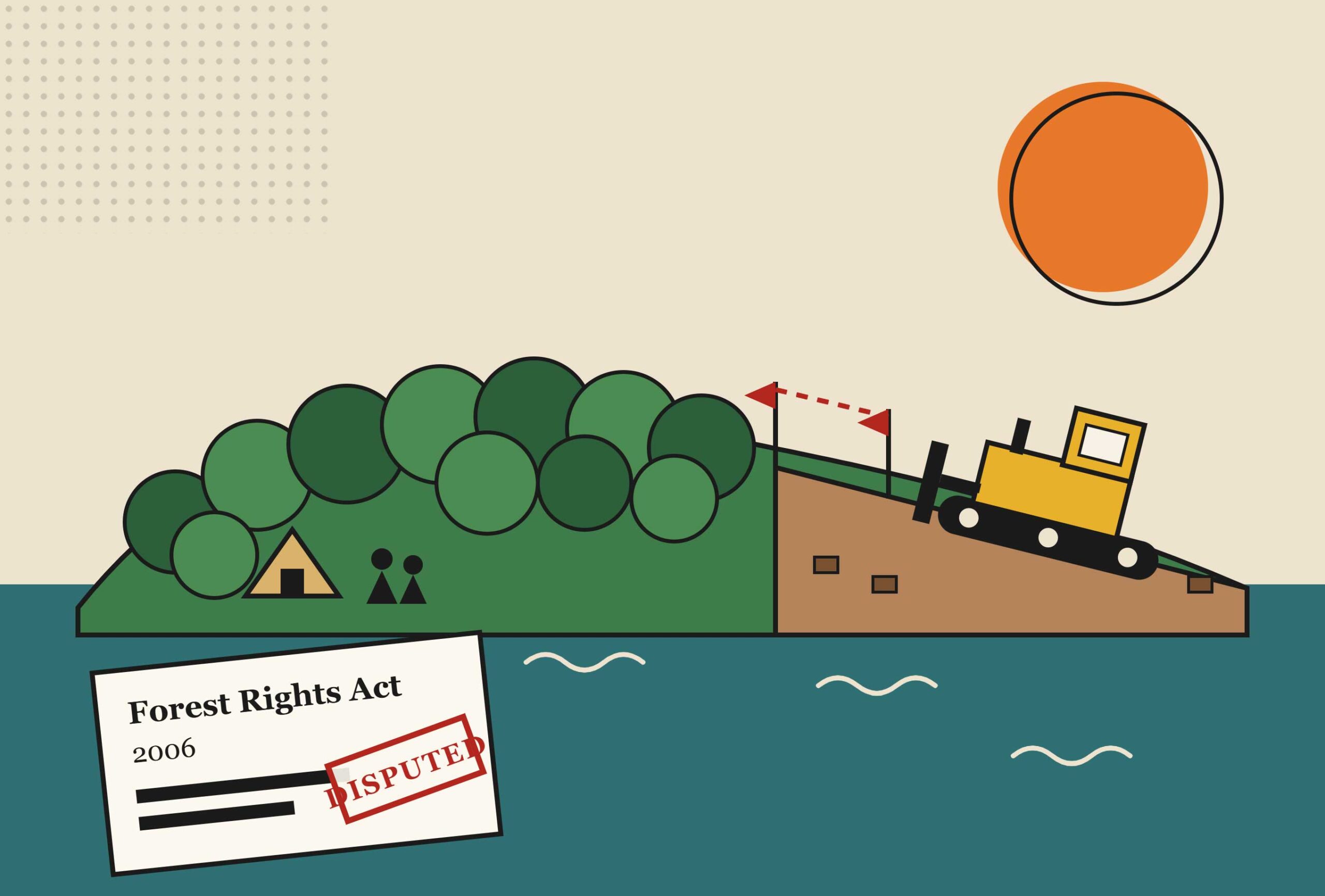
The Calcutta high court has deferred the final hearing regarding allegations pertaining to forest rights violations linked to the union government’s infrastructure projects proposed on the Great Nicobar Island in the Andaman and Nicobar Islands, states a report in the Hindu.
The final hearing will now be heard in the next calendar year, on January 12, 2027, because the Union government sought time to file more information, including an additional affidavit. On November 25, at the hearing in the Calcutta HC, the government argued that the Forest Rights Act, 2006, (FRA) does not need to be implemented in the Andaman and Nicobar Islands, the Hindu reported.
However, have opined to the media that both laws, the FRA 2006 and the Aboriginal Tribes Regulations, 1956, are applicable in the islands, and that any government claim suggesting otherwise is wrong.
Petitions regarding violation of rights under FRA
The Calcutta high court has been hearing a batch of petitions alleging violations of rights under the Scheduled Tribes and Other Traditional Forest Dwellers (Recognition of Forest Rights) Act, 2006 that will come about due to the Rs 92,000 crore-worth projects on Great Nicobar Island. These include an international trans-shipment container terminal, a greenfield airport, a township, a power plant and linked tourism facilities.
There have been serious arguments against this project on environmental grounds. First, this project will mean felling rainforest trees on 130 square kilometres of forest land. Social scientists have also raised concerns that diverting some of this land from the tribal reserve will affect the Shompen and Nicobarese indigenous communities who live on the island. The Shompen are listed as a Particularly Vulnerable Tribal Group (PVTG), and still choose to remain in low contact with outsiders.
The rights of both communities are recognised under regulations including the FRA 2006 and the Andaman and Nicobar Islands (Protection of Aboriginal Tribes) Regulation.
Activists, including a former official of the Union tribal and environment ministries, have filed petitions alleging that the communities’ rights under the FRA have been violated in the process of clearing the project, including in the way the gram sabha consent (which is mandatory under the FRA) was obtained.
In August 2025, the Tribal Council of Little and Great Nicobar had highlighted these FRA violations in a letter to Jual Oram, the Union minister for tribal affairs, alleging that the island administration had made a false representation to the Union government in August 2022 by claiming that processes under the FRA had been completed on the Islands when it had not been done.
On November 25 at the Calcutta high court, however, the Union government argued that the FRA is not implemented in the Andaman and Nicobar Islands, the Hindu reported. This, the government claimed, was because the Protection of Aboriginal Tribes Regulations, 1956, was already operational there.
The petitioners rebutted by noting that the Islands administration had already issued a certificate claiming that FRA rights have been settled, and that this is what was being challenged.
On Wednesday, the Additional Solicitor General of India Vikramjit Banerjee also submitted that the Union government wanted to once again raise preliminary objections on the maintainability of some of the petitions, and that it wanted to submit one more affidavit pertaining to tribal rights, with some additional documents.
‘Misleading arguments’
The FRA 2006 already recognised and vested forest rights with the communities when the FRA was enacted, commented Bijor C.R., who examines natural resource conflicts and governance issues.
Moreover, the Union ministry of tribal affairs had previously clarified that in such cases, a proactive recognition of these recognised rights under FRA 2006 is also to be done. In this case, this was not done. Per the ministry, in cases where the rights of people have been already documented (such as in Mizoram), Collectors may give a certificate to this effect to substantiate that no further procedure with regard to FRA is required. But this too has not been carried out, he pointed out.
‘Brazen callousness’: Jairam Ramesh
The Modi government has appeared to come forth with a fresh strategy to further stall and delay the high court proceedings, even after assuring the Supreme Court that it would cooperate to have the hearings completed as scheduled and having them argued yesterday itself, commented former environment minister and senior Congress leader Jairam Ramesh.
“The hearings have now been put off to January 13, 2027, because the Modi Govt suddenly discovered the need to file new affidavits,” he said in a post on social media platform X.
“Meanwhile, this ecological disaster of a project continues to get bulldozed through. Bids were invited on Oct 26th to demarcate the entire 166.1 sq km area earmarked for the project that includes about 122 sq km area of biodiversity-rich forest land. The boundary is itself of about 43 km. Tenders were thus invited just a month before the Calcutta High Court hearings demonstrating the utter contempt that the Modi Govt has for democratic processes. Its mind is made up and can be summed up thus: ‘Let the challenges meander their way through the courts but the project will go forward unhindered.’ This is brazen callousness. The havoc that it will cause is foretold.”
The court will hear the matter on January 13, 2027, when the petition that specifically deals with tribal rights and the FRA will be heard. Following this, the court has agreed to also hear the Attorney General’s submissions on behalf of the government on January 22.
Related:
A test for the Forest Rights Act in Assam
Supreme Court examines Forest Rights Act 2006 versus Conservation Law, makes national headlines