
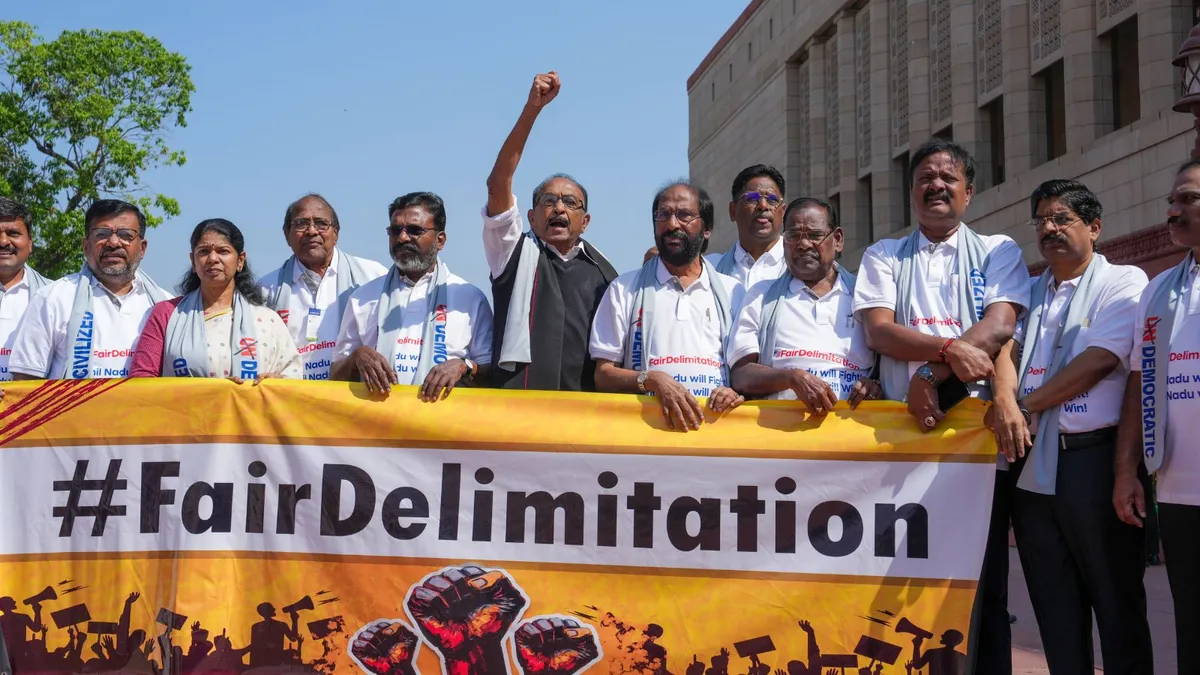
The process of SIR (Special Intensive Revision) is not yet complete; however, the Government of India has already initiated steps toward delimitation, which may significantly affect political representation.
Following delimitation, the parliamentary representation of southern Indian states is projected to decline from 23.6% to approximately 20%, whereas the representation of the Hindi-speaking northern and central states—where the Bharatiya Janata Party (BJP) has substantial electoral strength—is expected to increase from 38.1% to 43.1%. This shift enables the ruling BJP to maintain political dominance even without substantial support from southern states.
Beyond its federal implications, this issue also raises normative concerns regarding democratic principles.
The delimitation process is grounded in the principle of “one person, one vote and One Vote One Value”, that is the equal value of each vote. Ideally, each parliamentary or legislative constituency should represent a comparable number of voters across the country. Based on this principle, the allocation of seats in state assemblies and the Lok Sabha is determined.
For instance:
In the 2024 Lok Sabha elections, Uttar Pradesh (UP) had approximately 15.4 Crore registered voters and 80 parliamentary seats, implying that each Member of Parliament (MP) represented around 19.3 lakhs voters.
In contrast, Tamil Nadu (TN) had about 6.24 crore voters and 39 seats, with each MP representing roughly 16 lakh voters. This discrepancy suggests that the relative value of an individual vote varies across states.
From a theoretical standpoint, delimitation could address such disparities by standardising representation—for example, by ensuring one MP per 10-15 lakh voters nationwide. However, such an approach would increase representation for more populous states while comparatively reducing it for states that have achieved lower population growth.
This raises a fundamental question for a democracy with many regional complexities and existing regional imbalance in political representation:
How can equitable representation be ensured without exacerbating regional imbalances?
The Modi governments’ approach to delimitation intended to reinforce existing myopic political advantages for the BJP at the cost inciting regional unrest leading to centrifugal tendencies which is already brewing in the republic.
An additional dimension of the debate concerns the interaction between delimitation and SIR. While delimitation determines the number of parliamentary seats, SIR determines the electorate itself.
The combined effect of these processes result in disproportionate disadvantage to southern states. To illustrate let us take the examples of both UP and TN where the SIR process has been completed and check the impact of Delimitaion.
Under the proposed framework (based on the 2011 Census):
Uttar Pradesh’s Lok Sabha seats may increase from 80 to 143.
Tamil Nadu’s seats may increase from 39 to 49.
Following the SIR:
Uttar Pradesh is estimated to have approximately 13.39 Cr voters, after the SIR, resulting in one Member of Parliament (MP) per about 9.36 lakhs voters.
Tamil Nadu, after the SIR, is estimated to have around 5.67 million voters, leading to one MP per approximately 11.57 lakhs voters. Thus, disparities in voter-to-representative ratios would persist, with southern states potentially experiencing relatively lower vote value.
A similar pattern is projected for Karnataka. After delimitation, the state may receive 41 seats. Depending on changes in the voter base following SIR, the number of voters per MP could remain comparatively higher than in northern states.
In comparative terms, if all states were represented at the same ratio as Uttar Pradesh (approximately one MP per 9.36 lakhs voters), Tamil Nadu should get 60 seats instead of 49, with similar implications for Karnataka. Thus both the SIR and delimitation of the Modi government as currently proposed, is a lethal attack on Parliamentary Democracy.
It is for this reason that the country should say a clear NO to both the SIR and the Delimitation.
An alternative framework that preserves the principle of equal vote value while minimizing regional disparities in representation need to be evolved through democratic consultation with the People and States of the Republic.
Related:
“Inside the SIR”: Booklet flags ‘mechanical disenfranchisement’ in electoral roll revision
No Hearing, No Notice, Just Deletion: How Bengal’s SIR Erased a Decorated IAF Officer